Sunday, March 31, 2019

A lettered man

I am not an unlettered man. I neither lack in the facility to read or write. Give me the Bible and I can read from it at length and explain its passages.

marriage certificate jan franz van husum and volkje nordstrand

I do admit that I came across this ability late in life. Then, many things came to me late in life, marriage, children, property, status and wealth.

I was, in the beginning, a sea-going man, sailing from my home, the port of Husum, Schleswig Holstein. Sometimes called we called it Friesland because of the large numbers of Hollanders who to reclaim the marsh from the sea. My wife-to-be, Volkje was one of these Hollanders, living on the island of Nordstrand. It was the Dutchman Jan Adriaansz Leeghwater who came to supervise land-reclamation using dikes and wind mills. And for a time, man conquered nature.

But I get ahead of myself. The mind wanders of an old man wanders. So much time has passed. So many memories.

My sea-going was aboard a fishing boat. We sailed the waters of the North Sea catching cod, to be dried and salted, and sold. All Europe wanted cod. Spain and Portugal wanted cod, and so did other Mediterranean buyers, such as those in Italy. It could be sold for Spanish bullion, traded for English manufactured goods. It was a profitable business, but already new fishing grounds in Newfoundland were cutting into the market. This was an area that the Spanish and the Basque were capitalizing on. And even the Dutch recognized the potential of the New World. By 1624, the colony of New Netherland was established by the Dutch West India Company grew to encompass all of present-day city of New York, but then it was called New Amsterdam, and New York, New Holland.

It was old Kiliaen van Rensselaer, a wealthy Dutch merchant, who, in 1630, set up the manor where my wife and I first came. It was the same old man who encouraged my wife and I to leave Holland in 1639, to settle on his lands as indentured laborers, to learn to red and write, to become something of ourselves in this New World.

But before we could sail for the New Holland, it was necessary that Volkje and I marry. So we did. The marriage took place in the the Nieue Kirke, a few blocks from the port where we would board ship. I recall then that minister who precided over our marriage asked Volkje and I where we were born. It was then that we answered Nordstrand and Husum, and that is how I got my name. To signify our agreement to the marriage we both signed what is called a signum manus, I with cross and line though it and Volkje with a simple cross. This was by way of practice. I knew the rudiments of writing by then, but names were not used.

There was something that caused all this to happen. I do not speak of it often for it was terrible. It took the lives of Volkje's parents and ten thousand other lives. It was a flood of Biblical proportions like the Great Flood that only Noah and his family survived.

It is hard to speak of even at this time, some 30 years later. It was the Great Flood of October 1634. Having spoken of this calamity, I will leave it for later.

An old man tires quickly.


Friday, March 29, 2019

The Last Will and Testament of Jan Fransse van Hoesen

Caveat: The names are spelled variously according to where Jan and Volkje lived. The seaport in Nordfriesland where Jan came from is now spelled Husum, and is in north Germany on the Jutland Peninsula. In Frisian the town was spelled Hüsem.Volkje's name is spelled variously, as well as her place of birth, Nordstrand, an island off the Frisian coast near Husum. Their marriage certificate in Amsterdam spells the last name Hussum. The name evolved as branches of the family got further away from New York and moved to Pennsylvania, then to North Carolina, Virginia, Tennessee, Texas, and Kansas.

VAN HOOSE VAN HOOSER VAN HUSS FAMILY IN AMERICA by Joyce Lindstrom


On June 5, 1662, at Claverack on the Hudson, Jan Franse Van Hoesen bought from the Mahican Indians about half the present Columbia County including the site of the city of Hudson. The purchase price was 500 guilders in beavers, although one must wonder why the Indians needed beaver and not vice versa. Then again beaver to an Indian is more meaningful as a unit of exchange than paper or metal guilders. Ref-'The Albany Protocal, pp 566-575. The tract took in three clavers and extended southward to van Slechtenhorst’s land (about two miles of river shoreline) and eastward an uurgaan,or “hour’s going” (3 miles), over to the big Claverack creek.

Two Mahicans showed up before Johannes Provoost, clerk at the court of Fort Orange and the village of Beverwijck to affirm the sale, the two Indians being: one named Pamitepiet or in Dutch Kesjen Wey, and the other Hans Vos or in Indian Tatankenat.

The Will of Jan Fransz van Hoesen and his Wife, Volkje: A Case Study by Ruth Piwonka,  HollandSociety.org Winter 2011

No one lives forever, and Jan Fransse  Van Hoesen, ten years shy of his allotted three score and ten, preceded his wife in death, executing a joint will her, possibly on the evening of the 29th or the morning of the 30th of November, 1665, when Jan passed away "at about eleven o'clock in the forenoon". The will was drafted by a notary, Van Schelluyne.

JAN FRANSSE VAN HOESEN'S WILL

In the name of God, Amen. (On this day appeared) Jan Fransz van Hoesen and Volckie Jurriaens of. van Noortstrant, husband and wife, residing in Albany (known to the undersigned witnesses), he, van Hoesen, lying abed sick and she, Volckie Jurriaens, being sound of body, but both of them being in full possession and having the full use of their faculties, mind, memory and understanding, as far as outwardly appeared and could be observed, which appears, considering the shortness and frailty of human life, the certainty of death and the uncertain hour thereof, and wishing therefore to forestall the same by proper disposition of their temporal estate to be left behind, declared that without inducement, persuasion, or misleading on the part of any one, they had made, ordained and concluded this, their joint, reciprocal and mutual last will and testament, in form and manner as follows:

First and foremost they commend their immortal souls when they shall leave their bodies to the gracious and merciful hands of God, their Creator and Redeemer, and their bodies to a Christian burial; and whereas they, the testators, acknowledge that before the date hereof they had neither jointly nor severally made or executed any testamentary disposition, legacies, donations, or other bequests whatsoever, therefore, the said testators hereby declare that they hereby nominate and institute the survivor of both of them as his or her sole heir to all the property, real and personal, claims, credits, money, gold, silver, coined or uncoined, jewels, clothing , linen, woolens, household effects, etc., nothing excepted or reserved, which he or she who dies first shall vacate at death and leave behind, to do therewith as with his or her own free property , without contradiction or gainsay by any one, provided that the survivor of the two shall be held to bringup the six minor and unmarried children, namely, JURIAEN, aged 23 years; MARYA, aged 14 years; CATARINA, aged 12 years; JOHANNES, aged 10 years; JACOB, aged 8 years; and VOLCKERT, aged 7 years, until they are of age to marry; to rear them in the fear of the Lord and to train them and have them trained in an honest trade or profession whereby in due time they may earn their living and then, when they reach their majority, to turn over them as much as their two married children, to wit, Styntie Jans and Annetie Jans, have received, or the value thereof, with which the said testators consider that the survivor of them may suffice. Therefore, the survivor of the two shall be held to bind therefor especially their real and immovable property, such as houses and lands, both the house and lot situated here near the fort and the land lying below the fort. Furthermore, the testators hereby exclude and shut out the honorable orphan-masters and ever one else from the guardianship of the aforesaid children,and the administration of their estate, not being willing that they shall meddle therewith, and in their place they nominate and appoint the survivor of both of them as guardian.

We, the undersigned, declared for the honest truth that what is hereinbefore written is the last will and desire of the aforesaid testators, stated clearly and with due understanding of its meaning by both of them, which they caused to be reduced to writing as hereinbefore stated, and that, when the writing had progressed as far as above, the testator, Jan Fransz van Hoesen, wanted to get up from his bed and sit near the fire, where, on being taken there and put in a chair, he suddenly and unexpectedly gave up the ghost and died. Actum in Albany, on Monday the 20/30th of November 1665, at about eleven o'clock in the forenoon.

Cornelus Tonisen Bos Anthony Jansz D.V. Schelluyne, Secretary

Return to Husum

If the stars align and the fates allow, my wife Robin Van Huss, her sister Laurie, and I will gather in Copenhagen, Denmark, rent a car and cross the Storebælt Bridge to the Jutland Peninsula making the journey to town of Husum and nearby island of Nordstrand. These two places mark the starting points for the Van Huss family clan. What does one say about a place whose moniker is "the grey town by the sea"?

It is Home


Home to those who go by the following names: "Van Huis, Van Housen, Van Os, Van Hise, Van Ness, Van Asse, Van Hoose," according to Ancestry.com, and even Hooser without the "van". If you are from New York, then it is probably Van Hoesen or Van Heusen.

Did you know that all the land around Hudson, New York once belonged to Jan and Volkje. Only in America...

One is warned, like George Webber that "You Can't Go Back Home Again". Scorn awaits you. "You can't go back home to your family, back home to your childhood ... back home to a young man's dreams of glory and of fame ... back home to places in the country, back home to the old forms and systems of things which once seemed everlasting but which are changing all the time – back home to the escapes of Time and Memory." You Can't Go Back Home Again, Thomas Wolfe.


Should my wife and her sister get past this, they face the fact that nothing is as it was. Husum was once a quait fishing village, in which their penultimate ancestor Jan Franz Van Husum  was a "Sea-going man" and his wife to be, Volkje Van Nordstrand, a simple girl living with her parents and sister Annetje on a spit of land reclaimed from the sea. What they did for a living is mere conjecture, but why not guess? It is likely they raised geese and or cattle and wheat, which they took to the markets in the south.

The First Van Huss


A few lines above I mentioned "penultimate" ancestor and named Jan Franz Van Husem. I should explain. Jan and Volkje did not get their names until they married. They married in the  Nieuwe Kerk and the registrar asked them where they came from, Jan answering, "van Husum" from Husum, and Volkje, "Nordstrand". Penultimate because Jan was asked the name of his father, Franz, who technically becomes the ultimate Van Huss.


The idyllic life for Jan and Volkje ended on the night and day of 11–12 October 1634. A storm tide rose from the North Sea and struck the coast of North Frisia overrunning the dikes built to keep back the ocean, it drowned upwards of ten thousand deaths. Much of Nordstrand was washed away, the fishing industry devastated.


If catastrophe can be the cause of celebration it is that Jan met Volkje and the two went to Amsterdam, were married, and in 1642 sailed  on a boat to America.

Monday, March 18, 2019

The summer of '43


Summer of 1943, Beaumont, Kansas


Outside Beaumont in the bottom lands, the farmers raise corn, which they call maize and primarily used as forage for cattle, in the uplands on the rocky hillsides, the cattle grow fat grazing on the rich Kansas grass. Everyone is what they call "dirt poor" meaning that one hopes for a better life for one's children.

In Beaumont, the roads are dirt and few. The horse and buggy replaced by the Tin Lizzy, but Beaumont is small and one can walk from end to end in a matter of minutes.

Bob was 13, his brother Jim was 14. They lived on Main Street in a two bedroom house. Their father Fred was a cattle trader, his mother Beulah the postmistress, his grandfather Dr. Phillips, the town doctor. City houses had electricity and phones, party lines that neighbors could listen in on. A bank took in what little money there was from the cattlemen and farmers, who loaded their cattle and crops on the steam engines that stopped at the depot at the south end of town. The depot was next to the holding pens for the cattle and the two ponds that caught the rainfall when it came.

The railroad was the reason the town existed at all. Years later, the Frisco railroad stopped running and so did the town. They took up almost all the track, leaving only a short stretch and the historic water tower that is now the town's signature piece.

Last Night


My wife and I went to dinner with her father at the Cracker Barrel last night.

Bob Van Huss was born in 1929 in Beaumont, Kansas. He was 12 years old when World War II started. He and his brother Jim saw farm boys from Beaumont go off to war. And Bob and Jim would have heard this song on the radio in 1943 while they worked the farms in place of the boys who left.

Some never came home.

Bob has seen a lot. During the war and after, the steam engine trains came through Beaumont taking troops off to training camps and to war. Bob tells the story of the time the train stopped to take on water and refuel. Jackie Robinson was on the train with other recruits. They got off for a spell and, according to Bob, Jackie ran a foot race against all comers, and won.


Bob and his brother answered the call to serve their country, both served in the Army overseas. Jim fought in Korea. Sadly, Bob now suffers from memory loss, but he is staying at the Presbyterian Manor and I am glad to say, quite happy.

On a Wing and a Prayer


On the way to the restaurant and home again Bob sang the lyrics over and over again with a smile on his face. Oh, how he sang. There were stars in his eyes. The world was in bloom. Somewhere, it was spring again. Some memories are never forgotten.

Thought you might like to hear it:

Comin' in on a wing and a prayer
Though there's one motor gone
We still carry on
Comin' in on a wing and a prayer

What a show, what a fight!
Boys, we really hit our target tonight
How we sing as we limp through the air
Look below, there's our field over there
With just one motor gone
We still carry on
Comin' in on a wing and a prayer...


There are many recordings, but English vocalist Anne Shelton gives one of the best.


https://www.youtube.com/watch?v=B69CquvLHgY

Thursday, May 3, 2018

Making dough in America

They came by ship from Amsterdam to America, signed on for four years as indentured farmers, and in some cases as laborers and workers, to the wealthy Dutch diamond merchant, Kiliaen Van Rensselaer. They were on their way to a settlement called Rensselaerswyck.

Willem Juriaensz, the Baker

One such person was Willem Juriaensz, commonly called Willem the Baker (Bakker). Once, called Capitaijn, in 1646 and again, in 1650, Capiteijn Willem Jeuriaens, no doubt a reference to his prior career as a sea captain. Arriving in Rensselaer's colony in 1638, he worked on various farms as a baker, but beginning in 1644, was sentenced to banishment for misdeeds, and then reprieved.

One story goes something like this. Jochem Becker accused the old captain of stealing his hens. Jacob Willemz took up the captain's side in this story, saying, "What do you mean, they are the old captain's hens?" Becker called to Willemz to come out of the house. Willemz refused, and promptly Becker rushed in and giving him a sound beating and grabbing him by the throat, called him an "old dog". Willemz fought back as he could, and called Becker "a dog and a son of a bitch".

Whether the old captain stole the chickens was not, this time, a question for the court.

In 1647, he was again sentenced to banishment for attacking one, de Hooges with a knife. (This de Hooges, is presumably Antony de Hooges, business manager of Rensselaer's colony.) In 1650, despite his multiple reprieves, he was again sentenced to banishment to the Manhatans, but released to settle his affairs.

He struck up a relationship with Jan van Hoesen, and entered into a contract as baker dated Jan. 30, 1650. In November of 1651, Old Man Juriaensz (he was now 72), refused to honor the contract, and by January of 1652, the court gave Jan van Hoesen "permission to occupy the erf" (lot, or bakery) on the condition that the Old Man could live in the adjoining house "ofte de gelegenheijt," as long as he lived.
 O'Callaghan, History of New Netherland, 1, pages 437 and 438;
Van Rensselaer Bowier Manuscripts, page 820
.

Saturday, February 17, 2018

James Matthias Van Huss

The tree of life is broad, with branches far and wide, and many leaves.

James Mattias Van Huss, older brother of John Finley Van Huss (my wife's great grandfather), was the son of Valentine Worley VanHuss (1818–1908) and Lucinda H. Campbell (1818–1870); grandson of Matthias Van Huss and Elizabeth Worley.

Jamers was born 9 September 1845, on a farm, just east of Elizabethton, Carter County, Tennessee. The farm is still there, and a small family cemetery.

Unmarried and 25 years old, James left Tennessee in 1870 (therabouts), along with his parents and several brothers. Another branch of the Van Huss family remained in Tennessee and relatives can be found there today.

One imagines that they came by covered wagon, traveling a route close to US 50 that went through Jefferson City, Sedalia, and eventually Kansas City, before settling for a short while in the rolling hills of south Johnson County, Kansas. There James' mother Lucinda died, whether by illness or accident is unknown. Fairly quickly, the family moved on to Butler County and the several brothers took up homestead claims or purchased land near Beaumont, Kansas.

In 1875, James married Elmetta Lucinda Gifford. The marriage produced eleven children.

It could be that James and his wife settled in Glencoe Township, on 480 acres a half a mile west of Beaumont and just north of US400. There is a stone foundation left and the markings of a well and a pump. Hickory Creek begins to form here and there is a man made lake on the property now.

I say could be because I need to go to the county register of deeds to confirm that he purchased the property indicated on the 1885 Atlas of Butler County, Kansas.


By 1900, James (at the age of 55) and Elmetta were living in Grant County, Oklahoma. James died 6 July 1908, Hawley, Grant County, Oklahoma.

Wednesday, January 31, 2018

Wichita Stock Yards

My father-in-law mentioned the Wichita Live Exchange to me the other day, otherwise I would not have even thought of it. Bob is approaching the ripe old age of 90, and the subject came up when I asked what his father Fred Van Huss did for a living.

"My father was in the business of buying and selling cattle," Bob said. "This was before the war, I was nine or ten, and once in a blue moon, my dad took me to the the Exchange and got us odd jobs."

"Cleaning up cowshit?" I suggested, and he laughed.

"Mostly, we were in the way, so it wasn't often that my brother Jim and I got to drive with my father from Beaumont to Wichita."  "One summer I remember, my dad got us a job driving the cattle from pen to pen, after a sale. One little critter took a shine to me and rushed me, hitting me in the chest, and taking my breath away."

"My dad," he continued, "stayed in Wichita during the week, the drive to Beaumont was too far, and the roads too poor, to make it a daily trip. He partnered with two or three other cattle buyers so they could share the expense of an office in the exchange and a secretary."

There is precious little to remind Wichitans of the Live Stock Exchange.

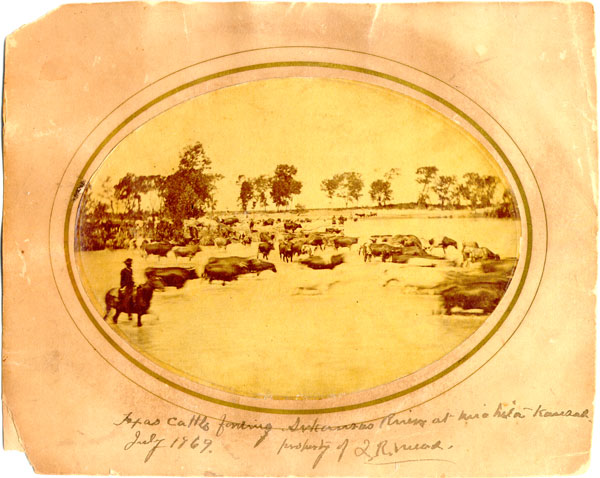
Way back when, writes J’Nell L. Pate in her 2005 book, America’s Historic Stockyards: Livestock Hotels, "The entire town of Wichita could be termed a stockyards as early as 1872 when the two-year-old settlement and trading post on the Chisholm Trail saw its first railroad, the Santa Fe, arrive. Citizens also worked to get the Western & Southwestern Railroad to connect to the Santa Fe and others. After its first year as a railhead, Wichita received 70,000 head of cattle worth at least $2 million."

J. R. Mead's photo of cattle crossing the Arkansas at Wichita 1869,
Wichita Photo Archive


In 1887, a stockyard was built at Emporia and 18th Street, but it burned down its first day of operation.

Wichita Live Stock Exchange


A second stockyards opened on January 1, 1888, then soon moved to north of 21st street when meat packer Jacob Dold agreed to build a plant next to the yard. He did. Then, in 1901, his packing plant caught fire.

Dold Plant, Wichita Photo Archives


Despite this bad luck, progress on the stockyards continued. Not only were cattle lots built, but a Stockyards' Hotel and Exchange Building were added, smack dab in the middle of the stockyards. Mind you, this was all 40 years before Fred Van Huss took up work at the Exchange. And before Fred arrived another fire destroyed the yard and the hotel in 1904. Then, in 1909, the Union Stock Yards Company decided to build a new Exchange Building, the one most old Wichita residents remember, and the one Fred worked at with his partners.

I don't know what a cattle buyer does or did, Bob didn't know either. Children often don't know what their fathers do.

I imagine that it involved the sale of slaughter cows and bulls, then breed cows, pairs of cows, and stock cattle and feeder calves, like it does today. And Fred got a commission on each sale.

In the midst of the stench from the packing and rendering plants, the Live Stock Exchange must have been impressive. The outside was a two story building with windows along the front. Inside the floors were of white marble, the walls of dark wood and glass. Visitors were greeted by two tile mosaics, one, on the first floor, a bull’s head measuring 40-inch by 45-inch. On the second floor, a 4 by 6 foot section of tiles proclaiming, "Market That Satisfies" surrounded by the contented heads of a cow, a horse, a pig and a sheep. The Exchange housed 15 livestock commission firms, one of which at one time was the little group that Fred belonged to, plus a national bank, the office for the president of the stockyard company, an office for the Wichita Terminal Railway Co., and branch offices for the packing houses. It must have been a merry group that played cards during off times, smoked cigars, and drank beer and something harder, even during the Prohibition Years.

In 1980, long after Fred Van Huss moved on, the stockyards shut down. And, in 2000, the Live Stock Exchange was razed to the ground.

Source: Wichita Historic Preservation Alliance