Showing posts with label Charles Dallas Miles. Show all posts

Tuesday, February 18, 2014

Brownlow Cemetery, Butler County, Kansas


The name Brownlow is a mystery, but there is a clue in a short bio of Hickory Township by J.O. Evertson, in Mooney's History of Butler County, Kansas.

Among the next arrivals [in Hickory] were J. A. Armstrong, who bought out Mr. Myers, and established a general store at Old Brownlow.
Id. page 160.


Brownlow cemetery lies on a bluff between Hickory and Honey Creeks. It is a bit tricky to get there and the turn off of 135th street is not marked. Take Highway 400 east of Augusta and Leon until you come to Munson Hill Road. Turn south on the gravel and make your way to 132nd street. Turn left on 132nd street and then right on Grove Road, a quick right on Hickory Road. The cemetery is off to the left.

Brownlow Cemetery, googleMaps


Brownlow Cemetery

Brownlow Cemetery, looking east
The cemetery is the resting place of many early settlers in Hickory Township.

Brewer Family

Include are the Brewer family that arrived in 1881. James Madison Brewer and Margaret Faubion Brewer came to Kansas by way of Allentown, Missouri, where they had lived 20 years; and they settled not far from Latham, Kansas.

When they came to Butler County (Kansas)-they came in covered wagons--three families together: Mary Jane & Joseph T Wright, Margaret & James BREWER, and Hephzibah "Aunt Hippy" & Mathew Hightower. The Hightower's son Otto took sick on the way, and they camped at Eureka (Greenwood County, KS) with him for 'quite a while.' The other families stayed with them for about a week before moving on. Otto died and was buried in Eureka Cemetery before the Hightower's wagon left camp to join the others in Butler County.

Brewer family history.


Wright family, Brownlow Cemetery
Brewer family, Brownlow Cemetery
Sensenbaugh family

In 1873 Paul and Sarah Sensenbaugh settled in Hickory Township, Butler County. Their son Henry was included in Mooney's History of Butler County at page 833.

He located on 160 acres of land and after getting four ponies, one of which was a spotted one, he proceeded to break his prairie land. His outfit might have seemed more appropriate in a circus parade, but he succeeded in tilling the soil and raising a crop with them. He also used oxen in the early days and frequently drove to dances with his ox team outfit. ... 

Miles, Charles Dallas

Brownlow Cemetery is also the resting place of Major Charles (Charlie) Miles (1921-2001) who served during World War II in China.

Major Charles (Charlie) Dallas Miles

Charles Dallas Miles, 1921-2001

Wednesday, April 10, 2013

The Great Dakota Boom

There will always be questions and questions will always remain unanswered. The question is why Frank and Fannie Miles settled in the Dakota Territory sometime before 1880 and why they left. Frank and Fannie Miles are the great-grandparents of my wife, and the grandparents of Charlie Miles, Mary Van Huss, and Joan Smith. They are the great-great-grandparents of my children Hannah and Will Davis.

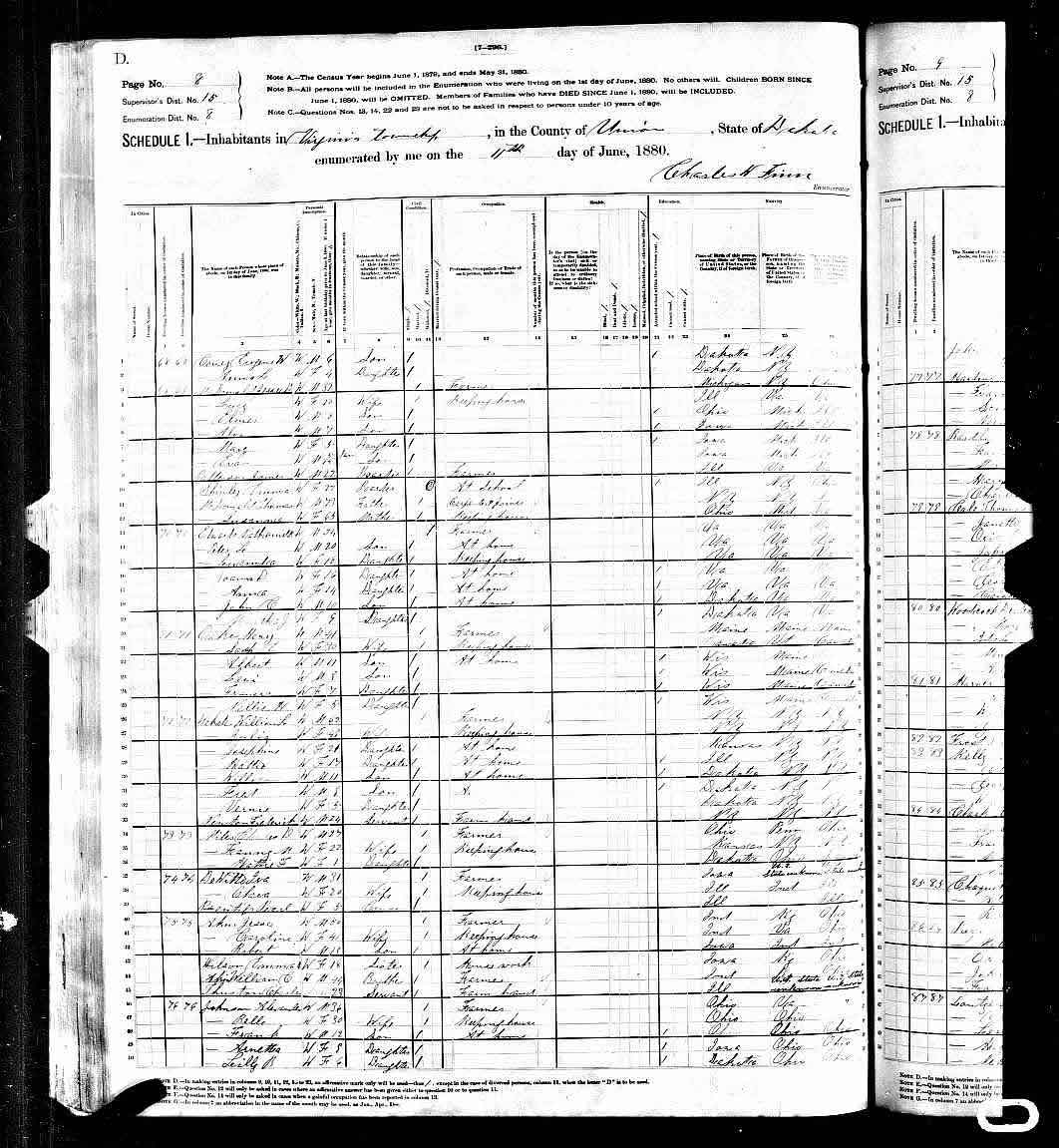
1880 US census, Dakota Territory, Virginia Township, Union County


The 1880 US Census records the fact that Frank Ottley Miles, his wife Fannie Brewster Miles and their one-year-old daughter Hattie lived on a farm in the southeast corner of Dakota Territory, Virginia Township, Union County. The farm was in the James River Valley north and east of Yankton. The census record is hard to read so I have cropped the image to reveal the names of Charles, farmer, age 27, Fannie, keeping house, age 21, and Hattie, age one. Hattie's place of birth is Dakota, so we know that the Miles family came to the Dakotas before 1879.

detail of 1880 US census

The land that the Miles family settled was formerly land owned by the Sioux. In 1858, the Yankton Sioux signed the 1858 Treaty, ceding present-day eastern South Dakota to the United States.

Middle Missouri River by Lewis and Clark, pub. 1814

Detail of Lewis and Clark map of the middle Missouri River, image from Wikipedia. The annotations states that between the Jacques [James] and Sioux rivers, "the different bands of the Sioux Indians meet each Spring to trade with each other and with white Traders who visit them."

Question: When did Frank and Fannie Miles arrive in Dakota territory?

In truth, I don't know. Nor do I know when they left, although I do know by the time of the 1900 census, the family moved on to Oklahoma where they again took up farming near Stillwater. The answer to both \questions should lie in the court records of the county where they lived. There the Register of Deeds would have recorded the Homestead claim that was filed, for a fee of $14, and the subsequent sale, when the family moved on to Oklahoma.

Question: What did Frank and Fannie find when they moved to the Dakotas?

The simple answer is not much. In 1880 there were few towns, few railroads, the James River Valley was just a flat fertile stretch of land that was eagerly sought by homesteaders. So eager were farmers for land in the Dakotas that between 1880 and 1890, the population of the entire Dakota Territory, both south and north, jumped threefold from 135,000 to over a half a million souls. They came, for the most part, with not much in their pockets. They through up simple frame house, or sometimes a sod house, where wood or money was scarce, and commenced to farm. To give one a sense of the magnitude of the land rush, consider that in 1880, when Frank and Fannie had already established their claim, almost 3 million acres were filed on. By 1884, this figure rose to over 11,000,000 acres. Read The Farmers' Frontier, 1865-1900, by Gilbert C. Fite, for a good discussion of the Dakota Land Rush.

Question: How did they fare?

There are no diaries or personal records of the young Miles family that record their years in the Dakotas. History records a great blizzard that first stuck in October of 1879 and continuing on throughout winter, dropping over ten feet of snow. School children were caught unawares by the sudden October snow storm and hundreds died of cold. The late spring that arrived eventually melted the snow and turned the flat James River Valley into an ocean of water. Still, new immigrants came. And those that survived the winter and the floods prospered in the early years. Bountiful rains throughout the early 1880's meant good crops, usually wheat, but also corn, rye, and barler, which allowed the farmer to earn a good living for his family.

By 1884, the Miles family had a new addition, a baby boy named Charles Dalles Miles. He was born in Sioux City, Iowa. That he was born there might suggest that the farm had been abandoned, or it might simply mean that Fannie had returned to Iowa to be near family or a hospital.

The Dakota land boom continued in 1885 and 1886 with new farmers arriving plowing up the tall prairie grass where buffalo once grazed and planting cereal grains instead. The year 1886 was to be a watershed, when drought again returned to the prairies and falling wheat prices aggravated plight of the farmer. In 1889, statehood finally came to North and South Dakota. Even then, by 1889-1890, the drought affecting the mid-west had become so bad that land that previously yielded 20 or more bushels and acre, were now down to 2 bushels or less. And, by the early 1890's, carloads of coal, food, and clothing was directed from the east to aid the struggling farmers and their families. Accompanying this natural disaster was the economic Panic of 1893. As a result of the bank panic, railroads which had been overbuilt, collapsed, banks which lent money on risky investments collapsed, wheat prices the source of the farmers income collapsed, mortgages were called, and farms foreclosed.The Panic of 1893 was, at the time, the worst depression experienced by the United States.

Some farmers, like the Miles family moved on, some adjusted by changing their farming practices, resorting to livestock, irrigating, or just plain luck of a fortunate rainfall, bringing in a crop. But all those families, like the Miles family demonstrated a desire to make something of nothing, to settle down and create a new life.

Read:
1.  History of Union County, Dakota Territory
2.  History of South Dakota, pub. 1915
3.  Digital Library of South Dakota
4.  History of Dakota Territory, by George Kingsbury, pub. 1915.
5.  A History of Union County, South Dakota, to 1880

Sunday, March 31, 2013

Charles D. Miles


Charles Dalles Miles, born in Ohio, July 1852, is the father of Frank O. Miles, and grandfather of Mary Miles, who is the wife of Robert (Bob) Van Huss.

Charles, like the majority of males in the United States in the second half of the 19th century, was a farmer. He first tried his luck in the Dakota territory around 1890, then, sometime later, moved on to Oklahoma, first near Stillwater and Payne County, then near Morrison, Autry Township, Noble County. He then moved to Arkansas before returning to Oklahoma, to be near his daughter Hattie. He and his wife Fannie May (Brewster) Miles are buried in the nearby Morrison cemetery.


Little is known of Charles other than the few facts that can be gleaned from the four US census records where his name appears. These records are from the following decades: 1880, 1900, 1910, and 1920 (the records of 1890 were destroyed in a fire). Even though Fannie died in 1935 and Charles in 1943, I have found no other records for them.

1880

The census record of 1880 reveals that Charles, then aged 27 and his wife, Fannie M., 5 years his junior, were living in the territory of Dakota. Statehood would not come until 1889. The census records the location as Virginia Township, Union County. The location is just north of Sioux City, Iowa and near the present town of  Hawarden, South Dakota. See Map. Charles and Fannie had, at the time, one daughter, Hattie F., who was then only one year old. Charles farmed while Fannie kept the house.

The other few tantalizing facts revealed by the census include Charles' place of birth, Ohio, and those of his father and mother, Pennsylvania and Ohio. Fannie's place of birth was Kansas, and those of her father and mother, both of New York.

US Census 1880 for Frank and Fannie Miles
The young Miles family had to endure the Hard Winter of 1880-1881. Snow fell in October and over the succeeding months, accumulated to over ten feet. When  a late spring finally arrived, the snows melted turning the flat prairie into a giant lake.

There are too many coincidence of name to mention them all. But, it seems appropriate to say a little about General Nelson Miles. As Nelson Miles was originally from Massachusettes, it is unlikely that there is any direct family connection.

Following General Armstrong Custer's defeat at the Battle of the Little Big Horn in 1876, General Nelson Miles was dispatched to track down Sitting Bull. The cause of all the trouble was the discovery of gold in the Black Hills of the Dakota territory. The Sioux naturally resisted the white man's incursions and war followed. The area where Charles and Fannie settled was the historic home of the Yankton Sioux.


1900

The census of 1900 places the family in Stillwater, Okalahoma, in Payne County. Frank and Fannie are now 47 and 42 years old, and one son, Frank O. Miles, age 16, born in Iowa, lives with them. (Note, the census record incorrectly lists Charles' father as being born in Ohio.)  Eleven year old Hattie is missing from the census. Son, Charles is helping on the farm. Charles owns his farm, but it is mortgaged to the bank.

US Census 1900, Frank and Fannie Miles

1910

Ten years later, when the census of 1910 is taken, the Miles family has moved to Noble County and Autry Township. Charles and Fannie are now aged 52 and 47; and, the household has again changed. Both children, Hattie and Frank are now gone. But there is the mysterious appearance of four new individuals. These are daughter, Elsie M. Duree, age 28, divorced;  granddaughters Alpha A. and Hattie O., ages 7 and 5, and a hired-man, Sirie Crits, age 21.

Now I said that both Hattie and Frank had left the household, but then, who is Elsie M. Duree?  And how is it that the 1910 census says that Charles and Fannie are only 5 years older than the 1900 census? Shouldn't they be 57 and 47, respectively?

One has to be mindful that census recorders can err. Then too, we all like to lie about our age, and shaving five years off is not an uncommon thing.

The bigger mystery for me is, "Who is Elsie M. Duree?"

Hattie, Charles and Fannie's daughter, was 31 years old in 1910. She appears on another 1910 census record, and married to Allison (A) A. Hileman. Hattie died and was buried in the Morrison cemetery in Oklahoma alongside her husband.

[Charles Dallas Miles and Frances May Miles are also buried in the Morrison cemetery.]

Could it be that Elsie is a third child?

The 1910 census records that Fannie had four children, three of whom were living at the time the 1910 census was taken. Don't know, but this is the first and last time Elsie's name appears. Need more research.


US Census 1910, Frank and Fannie Miles
1920

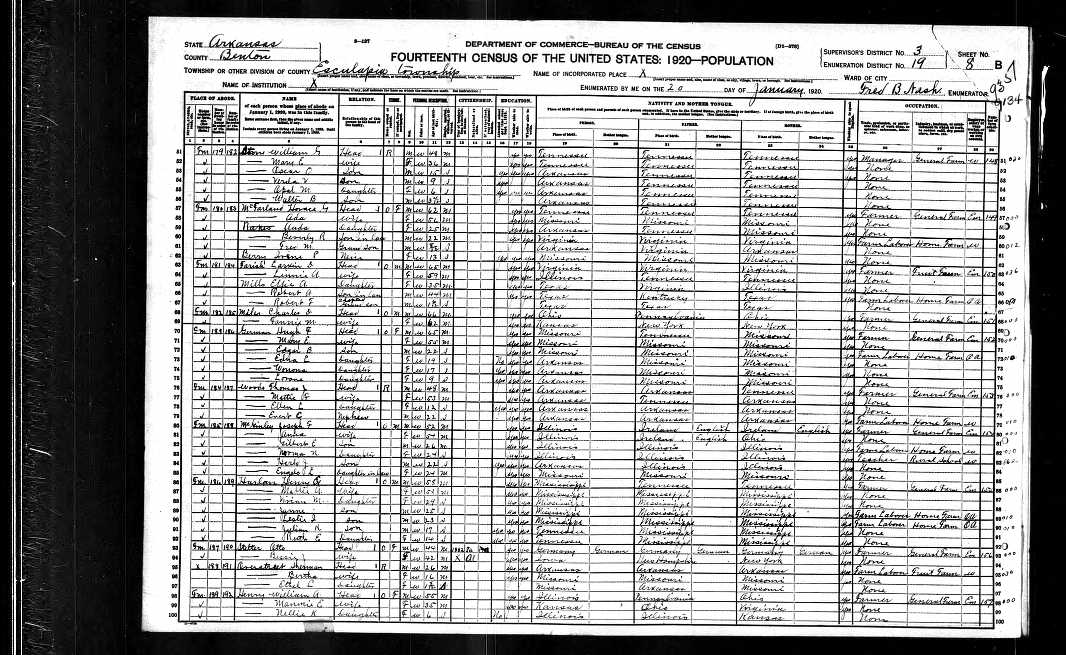
By 1920, Charles and Fannie, now living alone and listed at the ages of  66 and 62,  have moved on to Esculapia Township, Benton County, Arkansas. Charles is still farming.

US Census 1920, Charles and Fannie Miles


1940

The 1940 census records that Charles Miles, age 86, was living with his daughter Hattie, age 61, and her husband A.A. Hileman in Otoe, Pawnee County, Oklahoma. [I haven't seen the record.] The reference to Otoe, an Indian tribe related to the Sioux, fuels the family lore that the Miles family is part Indian.

Morrison Cemetery

The Morrison cemetery records Fannies's death as 1935 and Charles in 1943.


Monday, April 2, 2012

Fannie Webster Miles

Fannie Webster Miles born 1857 in Bleeding Kansas. Fannie would eventually grow up and marry Charles Dallas Miles.

But, before that, ... Fannie was the second daughter of William and Julia Webster, who had lived in California long enough for Fannie's older sister Martha to be born. Fannie's parents, William and Julia farmed 4,000 acres near Garnett in Anderson County, Kansas. Fannie and Martha would be joined by another sister Josephine, who was born in 1859.

What was life like for these three little girls?

Kansas in 1857 was in the midst of the Border War between Pro-Slavery advocates from Missouri and Free-State settlers. In May of 1856, a group of Border Ruffians entered the Free-State stronghold of Lawrence, burned the Free State Hotel, destroyed newspaper offices, and ransacked homes and stores. That same month, John Brown attacked at a pro-slavery settlement on Pottawatomie Creek. Brown and his group, which included four of Brown's sons, led five pro-slavery men from their homes and hacked them to death with broadswords.

In August, thousands of pro-slavery men from Missouri marched into Kansas. That same month, Brown engaged 400 pro-slavery soldiers at the "Battle of Osawatomie." Hostilities raged for another two months until Brown departed Kansas Territory.

In 1857, differing Kansas constitutional conventions were convened, with the opposing sides sparring over which was legitimate. One last outbreak of violence was touched off by the Marais des Cygnes massacre in 1858, where Border Ruffians killed five Free State men.

If border ruffians weren't bad enough, in 1860 there was a terrible drought.  No appreciable rain fell the entire Spring and Summer. Pottawatomie Creek ran dry. One family of ten survived on wild plums and the milk from one cow. In July hot winds blew from the southwest, drying the earth and opening cracks that horses and cows would step into. Half the population of the territory left.

When the 1860 U.S. Census was taken, it was recorded that 466 families and 2,398 souls remained in Anderson County. In Monroe Township, just outside the city of Garnett where the Websters farmed, approximately 240 individuals are listed.

From the 1860 U.S. Census for Anderson County, Monroe Township, Kansas, page 27.

Webster Wm. T. 41 M farmer 4,000 1,000 N.Y. REMARKS: middle initial could be "F."
(My note. Could it be William L. Webster? See a History of Anderson County, Kansas below.)
Webster Julia 28 F Mich
Webster Martha 5 F California
Webster Fanny 3 F Kansas
Webster Josephine 1 Kansas
*unkly Frank 24 M Servant 1,000 New Hamp.
Read the History of Anderson County, Kansas online.

From that history at page 72 is a description of a meeting held on the 15th of August, 1857 in the timber near the home of A. Simons. Nominated as delegates to the district convention include William L. Webster. This was part of the Free State Convention.

At page 87, it is noted that on March 9, 1858, William L. Webster and two others were nominated as delegates to the Free State Convention.

The 1870 U.S. Census for the state of Kansas, Monroe Township does not include William Webster or any Websters.

Miscellaneous.

From William G. Cutler's History of the State of Kansas online.

February 27, 1860, was chartered the State Line, Osawatomie and Fort Union Railroad Company. The road was to commence at some point of Lykins County, and run southwesterly to the south boundary of the Territory, in the direction of Fort Union. Corporators: E. W. Robinson, John B. Schofield, A. Hunt, R. Gilpatrick, W. F. M. Arny, John T. Cox, O. E. Learnard, G. W. Nelson, J. C. Lambden, Dr. Ashmore, Thomas Lindsey, William L. Webster, Penrose Johnston and P. G. D. Morton.

From The History of Anderson County, by W. A. Johnson, online, page 81.

On the 22nd of December, 1857, W.L. Webster was appointed superintendent of public buildings in Anderson county.

The year 1859, County Treasurer, William Webster, page 149.

Tuesday, March 27, 2012

Hattie Frances Hileman

On the sixth day of Spring, 2012, I visited, on a lark, the cemetery in Morrison, Oklahoma. There is little left of Morrison. The town has been reduced to a train stop and a bank. The farms surrounding Morrison use nearby Perry or Pawnee, Oklahoma for groceries and other needs.

Although I did not know it at the time, my wife's maternal great grandparents Charles Dallas Miles and Fannie Webster Miles are buried in the Morrison cemetery. Charles and Fannie were married in Sioux City, Iowa, homesteaded in Union County, South Dakota, and migrated to Stillwater, Oklahoma in 1900. A year later they moved to a farm near Morrison, Oklahoma.

Also buried in the Morrison cemetery is Hattie Frances (Miles) Hileman, daughter of Charles and Fannie, and sister to Frank Miles. I did find Hattie's marker, but I did not find those of Charles and Fannie.

Morrison Cemetery

From the records of Morrison Cemetery, Morrison, Oklahoma. See also, USGWARArchives.
Charles Dallas Miles, born 11 Jul 1854, died 21 Feb 1943, H. of Fannie Webster Miles Fannie, born May 1964 [sic, Note. the census records state that Fannie was one year younger than Charles, so, presumably, the date should be 1855 or 1856.], died 1935, W. of Charles
Hattie Frances Hileman, born 19 Jul 1878, died 12 Dec 1952 , wife of A. A. Hileman.


Morrison Cemetery, Noble County, Oklahoma

Hattie was the daughter of Charles and Fannie Miles. She was born in South Dakota. She appears in the Census of 1880, Union County, South Dakota. Her younger brother Frank O. Miles was born six years later in 1884.  By the time of the Census of 1900, Payne County, Oklahoma, Hattie was 22 and presumably married, as she was not living at home.

See article on Frank O. Miles.

Frank O. Miles migrated from Oklahoma to the oil fields near El Dorado around 1918. He then went off to Algeria before returning to El Dorado to raise his family. The family consisted of Charles (Charlie Jr.), who was born in Algeria, and later, two daughters Mary and Joan, who were both born in El Dorado. Mary would marry Robert Van Huss and they would have five children, the oldest of which, Robin, is my wife.

I happened to be traveling south this Spring (March 2012) and decided to take the short detour off of I-35 to Perry, Oklahoma. Perry is the county seat for Noble County and, so, is the depository for all land deeds in the county. I was hoping to get lucky and find the transfer of title to Charles Miles, father of Frank.

I didn't, but that wasn't the fault of the court records. From a History of Noble County, I found a reference to Hattie Frances Hileman, born South Dakota, daughter of Charles Miles. Her older brother was Frank O. Miles. She had married A. A. Hileman and their grandson Eugene Webb was deserving of a short bio in the History of Noble County. He was a farmer and rancher of note.

The bio quoted Hattie as relating that her grandfather lived on a ranch two miles east of Morrison, Oklahoma. The only other note was that her grandfather Charles had hand dug a well that was still in use in 1986.

I drove to Morrison. It is 15 miles due east of Perry and right off of the Tulsa Turnpike. Like so many small towns, its glory has long since faded. One mile to the east, just past the Long Branch Creek bridge is the turn off to the cemetery where Hattie is buried. I found the markers for Hattie, but did not see the markers for Charles and Fannie.

The countryside is beautiful in the Spring. The grass has sprouted green, the cattle graze outside the cemetery, and a pond shimmers in the distance. It is a good place to rest.

And, by the way, two miles east of Morrison puts you in Pawnee County. So, that is why Noble County had no land records.