Showing posts with label Frank O. Miles. Show all posts

Wednesday, April 10, 2013

The Great Dakota Boom

There will always be questions and questions will always remain unanswered. The question is why Frank and Fannie Miles settled in the Dakota Territory sometime before 1880 and why they left. Frank and Fannie Miles are the great-grandparents of my wife, and the grandparents of Charlie Miles, Mary Van Huss, and Joan Smith. They are the great-great-grandparents of my children Hannah and Will Davis.

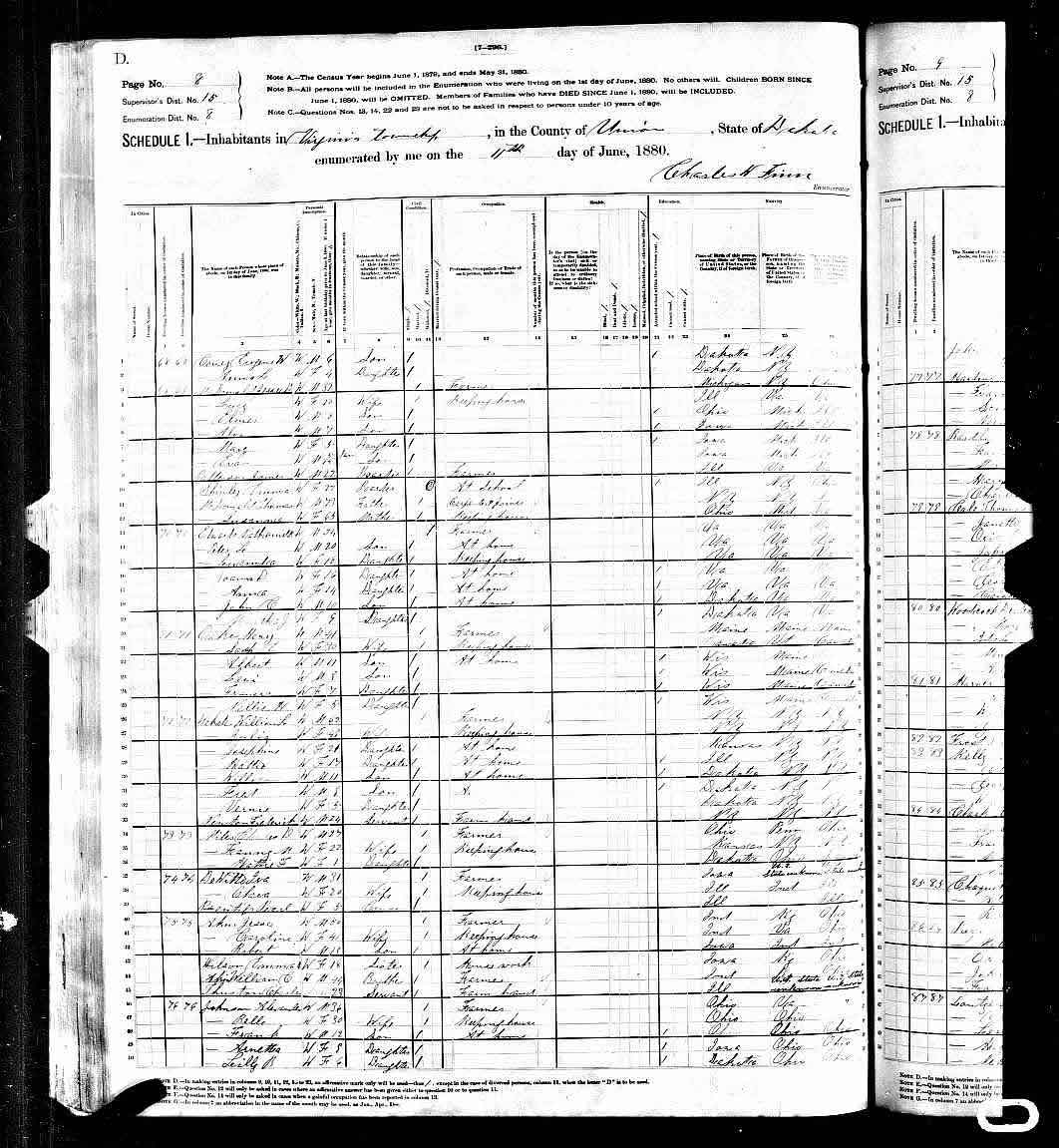
1880 US census, Dakota Territory, Virginia Township, Union County


The 1880 US Census records the fact that Frank Ottley Miles, his wife Fannie Brewster Miles and their one-year-old daughter Hattie lived on a farm in the southeast corner of Dakota Territory, Virginia Township, Union County. The farm was in the James River Valley north and east of Yankton. The census record is hard to read so I have cropped the image to reveal the names of Charles, farmer, age 27, Fannie, keeping house, age 21, and Hattie, age one. Hattie's place of birth is Dakota, so we know that the Miles family came to the Dakotas before 1879.

detail of 1880 US census

The land that the Miles family settled was formerly land owned by the Sioux. In 1858, the Yankton Sioux signed the 1858 Treaty, ceding present-day eastern South Dakota to the United States.

Middle Missouri River by Lewis and Clark, pub. 1814

Detail of Lewis and Clark map of the middle Missouri River, image from Wikipedia. The annotations states that between the Jacques [James] and Sioux rivers, "the different bands of the Sioux Indians meet each Spring to trade with each other and with white Traders who visit them."

Question: When did Frank and Fannie Miles arrive in Dakota territory?

In truth, I don't know. Nor do I know when they left, although I do know by the time of the 1900 census, the family moved on to Oklahoma where they again took up farming near Stillwater. The answer to both \questions should lie in the court records of the county where they lived. There the Register of Deeds would have recorded the Homestead claim that was filed, for a fee of $14, and the subsequent sale, when the family moved on to Oklahoma.

Question: What did Frank and Fannie find when they moved to the Dakotas?

The simple answer is not much. In 1880 there were few towns, few railroads, the James River Valley was just a flat fertile stretch of land that was eagerly sought by homesteaders. So eager were farmers for land in the Dakotas that between 1880 and 1890, the population of the entire Dakota Territory, both south and north, jumped threefold from 135,000 to over a half a million souls. They came, for the most part, with not much in their pockets. They through up simple frame house, or sometimes a sod house, where wood or money was scarce, and commenced to farm. To give one a sense of the magnitude of the land rush, consider that in 1880, when Frank and Fannie had already established their claim, almost 3 million acres were filed on. By 1884, this figure rose to over 11,000,000 acres. Read The Farmers' Frontier, 1865-1900, by Gilbert C. Fite, for a good discussion of the Dakota Land Rush.

Question: How did they fare?

There are no diaries or personal records of the young Miles family that record their years in the Dakotas. History records a great blizzard that first stuck in October of 1879 and continuing on throughout winter, dropping over ten feet of snow. School children were caught unawares by the sudden October snow storm and hundreds died of cold. The late spring that arrived eventually melted the snow and turned the flat James River Valley into an ocean of water. Still, new immigrants came. And those that survived the winter and the floods prospered in the early years. Bountiful rains throughout the early 1880's meant good crops, usually wheat, but also corn, rye, and barler, which allowed the farmer to earn a good living for his family.

By 1884, the Miles family had a new addition, a baby boy named Charles Dalles Miles. He was born in Sioux City, Iowa. That he was born there might suggest that the farm had been abandoned, or it might simply mean that Fannie had returned to Iowa to be near family or a hospital.

The Dakota land boom continued in 1885 and 1886 with new farmers arriving plowing up the tall prairie grass where buffalo once grazed and planting cereal grains instead. The year 1886 was to be a watershed, when drought again returned to the prairies and falling wheat prices aggravated plight of the farmer. In 1889, statehood finally came to North and South Dakota. Even then, by 1889-1890, the drought affecting the mid-west had become so bad that land that previously yielded 20 or more bushels and acre, were now down to 2 bushels or less. And, by the early 1890's, carloads of coal, food, and clothing was directed from the east to aid the struggling farmers and their families. Accompanying this natural disaster was the economic Panic of 1893. As a result of the bank panic, railroads which had been overbuilt, collapsed, banks which lent money on risky investments collapsed, wheat prices the source of the farmers income collapsed, mortgages were called, and farms foreclosed.The Panic of 1893 was, at the time, the worst depression experienced by the United States.

Some farmers, like the Miles family moved on, some adjusted by changing their farming practices, resorting to livestock, irrigating, or just plain luck of a fortunate rainfall, bringing in a crop. But all those families, like the Miles family demonstrated a desire to make something of nothing, to settle down and create a new life.

Read:
1.  History of Union County, Dakota Territory
2.  History of South Dakota, pub. 1915
3.  Digital Library of South Dakota
4.  History of Dakota Territory, by George Kingsbury, pub. 1915.
5.  A History of Union County, South Dakota, to 1880

Saturday, March 16, 2013

Frank Miles in the 1920's

I have already written that Frank Miles went to the oil fields in French Algeria where he met his wife to be, Maria Llabres. They married and,

"...in November of 1925, Frank, his wife Maria, and baby son Charles left Bordeaux [France] for New York aboard the French liner Le Bourdonnais. They settled in Spring Township, Butler County where they remained for the rest of their lives raising their three children Charlie, Joan, and Mary. Maria would remain on the farm with one exception, a trip that she took with her daughter Mary in the late summer of 1954 when she traveled back to France and Algeria to visit relatives."
Arriving as they did in 1925, the small Miles family just missed the devastating tornado of 1924 which struck Augusta Kansas.

Augusta tornado 1924, Bob Bergman
No luck in identifying the nature of the Snodgrass building. A Snodgrass genealogy lists R.L. Snodgrass of Augusta, Kansas, but identifies him as a farmer.

The Miles family grew up near the small community of Haverhill. The son Charlie and the two daughters to come, Joan and Mary (born Mary Maria Miles in 1931), went to school in Leon, walking the dirt road two miles there and back each day. Frank continued to work as an oilman, but it is unknown which company he worked for. It could have been for any of the several refineries in El Dorado, but then it could have also been for one of the three refineries in nearby Augusta.

Oil derrick circa 1920

Photograph from Kansas Memory - Mr. Eliga Carter at Gordon oil field, El Dorado, Kansas.

There is precious little to know of the decade of the twenties. Today, one traveled from Wichita to Augusta in fifteen minutes, but the trip took planning. Not until 1924, was a two lane brick road laid between Wichita and Augusta. Beyond that to Leon and Haverhill where the Miles lived, and to Beaumont, where the Van Huss family lived were dirt roads, impassable when it rained.

The 1920's were a time of change for cities. The streets were paved, and street lights put in. Small grocery stores popped up. Many a lad got his first job stocking shelves with goods and carrying out bags for customers. State law closed businesses on Sunday. Local bands provided weekend entertainment.

Cinemas came to town in the 20's. And the popular movies of the 1920's were such fare as "The Perils of Pauline" and "Buck Rogers" and westerns, like those of William S. Hart and Tom Mix. Not until 1927, did talkies first appear with Al Jolson in the "Jazz Singer."


Cars which had only made their appearance 20 years earlier, now edged out the horse and buggy on the streets and roads. In 1927, Henry Ford watched the 15 millionth Model T roll off the assembly line. It sold for a whopping $260. The oil industry that Frank Miles worked for, would fuel the growth in automobile transportation.


Tuesday, June 5, 2012

Maria and the Lapins

Lapins by Theodore de Banville

Lapins Rabbit
Les petits lapins, dans les bois,
Folâtrent sur l'herbe arrosée
Et, comme nous le vin d'Arbois,
Ils boivent la douce rosée.

Gris foncé, gris clair, soupe au lait,
Ces vagabonds, dont se dégage
Comme une odeur de serpolet,
Tiennent à peu près ce langage :

"Nous sommes les petits lapins,
Gens étrangers à l'écriture,
 Et chaussés des seuls escarpins
 Que nous a donné la nature.

Nous sommes les petits lapins.
C'est le poil qui forme nos bottes,
Et, n'ayant pas de calepins,
Nous ne prenons jamais de notes.

Et dans la bonne odeur des pins
Qu'on voit ombrageant ces clairières
Nous sommes les petits lapins
Assis sur leurs petits derrières."

Little bunnies in the woods,
Frolicking on the watered grass
And, as we the Arbois wine,
They drink the sweet dew.

Dark gray, light gray, milk soup,
These vagabonds, which emerge
Like a scent of thyme,
They take a little like this speech:

"We are the little bunnies,
Strangers to writing,
And like stockings to the shoes
That nature gave us.

We are small rabbits.
This is the hair that makes up our boots,
And, having no notebooks,
We never take notes.

And in the sweet smell of pine
Seen shading by these clearings
We are small bunnies
Sitting on their little behinds. "


The other day, Joan told the story that follows about her mother Maria and the rabbits. The poem has little to do with the story, but I thought it set the mood. But, before I tell the story of Maria and the rabbits, a little story about how Maria came to live in Kansas.

Joan and Mary's mother was Maria Llabres. She was born in 1895 in Sóller, Majorca, the largest of the Balearic Islands that lie off the southeastern coast of Spain. Maria's parents ran a small hotel whose name is lost to posterity. (A hotel, the Fonda Llabres can still be found in Sóller, but there is no known connection.)

Photos of Fonda Llabres, Alcudia

This photo of Fonda Llabres is courtesy of TripAdvisor,

Sóller is the real thing, a popular tourist destination and quaint Majorcan town near the sea, embraced by the Tramuntana mountains and surrounded by dense woods. Then, it was an out of the way seaport that exported wine, the island's main crop. The 1890's experienced a devastating disease that devastated the vineyards. Likely because of this, the family would move to Bone, French Algeria.  Maria grew up and in the early 1920's met a young oil worker from Kansas by the name of Frank Miles. They married, lived in Algeria for a couple of years. A son, Charlie, was born. But soon the young family returned to El Dorado, Kansas. Frank worked on the oil fields until he retired. In the meantime, Joan, then Mary, were born.

Joan's Story - Maria and the Rabbits.

The family of five lived on a small farm along Haverhill Road. It was four miles to Leon, the closest town. Joan and Mary grew up during the worst years of the Great Depression. Times were tough.

Living on a farm, Maria's English never became polished, and even 50 years later, when I met her for the first time she still spoke in broken English with a French word thrown in here and there.

The story that Joan told was about Maria and the rabbits, or in French lapins. Being French, Maria loved to hunt rabbits. Rabbits were a welcome addition to the dinner table. Lapin a La Cocotte - rabbit stew with a bit of bacon, some onions and parsley, bay leaves and thyme for seasoning is a tasty fair. Add a little red wine to the stew, which Maria loved and it was heavenly. To hunt rabbits Maria took her shotgun into the fields. One day Maria brought home a pair of rabbits, brown and grey, and plump, just right for a rabbit stew or a rabbit pie. Maria had brought the rabbits into the kitchen and she was preparing to skin them when there was a commotion in the front yard of the farm. An old Ford pickup truck screeched to a halt. A thick cloud of dust followed the farmer who got out of the truck and angrily went to speak with Frank. It seems that Maria in her rabbit hunt had accidentally shot through an open window of the farmer's house. The shotgun blast had come within a whisker of the crib where his infant child was peacefully sleeping.

Frank was able to eventually soothe the anger of his neighbor and send him on his way. As for Maria, she would continue to hunt her lapins, only not so close to the neighbor's house.


Tuesday, March 27, 2012

Hattie Frances Hileman

On the sixth day of Spring, 2012, I visited, on a lark, the cemetery in Morrison, Oklahoma. There is little left of Morrison. The town has been reduced to a train stop and a bank. The farms surrounding Morrison use nearby Perry or Pawnee, Oklahoma for groceries and other needs.

Although I did not know it at the time, my wife's maternal great grandparents Charles Dallas Miles and Fannie Webster Miles are buried in the Morrison cemetery. Charles and Fannie were married in Sioux City, Iowa, homesteaded in Union County, South Dakota, and migrated to Stillwater, Oklahoma in 1900. A year later they moved to a farm near Morrison, Oklahoma.

Also buried in the Morrison cemetery is Hattie Frances (Miles) Hileman, daughter of Charles and Fannie, and sister to Frank Miles. I did find Hattie's marker, but I did not find those of Charles and Fannie.

Morrison Cemetery

From the records of Morrison Cemetery, Morrison, Oklahoma. See also, USGWARArchives.
Charles Dallas Miles, born 11 Jul 1854, died 21 Feb 1943, H. of Fannie Webster Miles Fannie, born May 1964 [sic, Note. the census records state that Fannie was one year younger than Charles, so, presumably, the date should be 1855 or 1856.], died 1935, W. of Charles
Hattie Frances Hileman, born 19 Jul 1878, died 12 Dec 1952 , wife of A. A. Hileman.


Morrison Cemetery, Noble County, Oklahoma

Hattie was the daughter of Charles and Fannie Miles. She was born in South Dakota. She appears in the Census of 1880, Union County, South Dakota. Her younger brother Frank O. Miles was born six years later in 1884.  By the time of the Census of 1900, Payne County, Oklahoma, Hattie was 22 and presumably married, as she was not living at home.

See article on Frank O. Miles.

Frank O. Miles migrated from Oklahoma to the oil fields near El Dorado around 1918. He then went off to Algeria before returning to El Dorado to raise his family. The family consisted of Charles (Charlie Jr.), who was born in Algeria, and later, two daughters Mary and Joan, who were both born in El Dorado. Mary would marry Robert Van Huss and they would have five children, the oldest of which, Robin, is my wife.

I happened to be traveling south this Spring (March 2012) and decided to take the short detour off of I-35 to Perry, Oklahoma. Perry is the county seat for Noble County and, so, is the depository for all land deeds in the county. I was hoping to get lucky and find the transfer of title to Charles Miles, father of Frank.

I didn't, but that wasn't the fault of the court records. From a History of Noble County, I found a reference to Hattie Frances Hileman, born South Dakota, daughter of Charles Miles. Her older brother was Frank O. Miles. She had married A. A. Hileman and their grandson Eugene Webb was deserving of a short bio in the History of Noble County. He was a farmer and rancher of note.

The bio quoted Hattie as relating that her grandfather lived on a ranch two miles east of Morrison, Oklahoma. The only other note was that her grandfather Charles had hand dug a well that was still in use in 1986.

I drove to Morrison. It is 15 miles due east of Perry and right off of the Tulsa Turnpike. Like so many small towns, its glory has long since faded. One mile to the east, just past the Long Branch Creek bridge is the turn off to the cemetery where Hattie is buried. I found the markers for Hattie, but did not see the markers for Charles and Fannie.

The countryside is beautiful in the Spring. The grass has sprouted green, the cattle graze outside the cemetery, and a pond shimmers in the distance. It is a good place to rest.

And, by the way, two miles east of Morrison puts you in Pawnee County. So, that is why Noble County had no land records.

Thursday, December 29, 2011

Frank O. Miles

Frank Ottley Miles was born in 1884 in Sioux City, Iowa. He was the second child of Fannie May (Brewster) and Charles Dallas Miles. An older sister, Hattie was born in 1879.

[The census records of 1880 and 1900 suggest that Charles and Fannie had only one other child, a daughter named Hattie, born 1879. But in the 1910 census the name "Elsie Duree," daughter , divorced, appears with two grandchildren. The census records that Fannie had three living children, a fourth was deceased.]

Frank Ottley Miles is my wife's grandfather and father to Mary Van Huss, Charlie Miles and Joan Smith. By trade he was an oil rig builder. In the 1920's he traveled to French Algeria where he met and wed Maria Llabres. His travels also included trips to Angola, French West Africa, and the Belgian Congo.

1880 - Dakota Territory 

In 1880, before Frank was born, Charles and Fannie Miles homesteaded in the Dakota territory. Their farm was located in  Virginia Township of Union County. On Google maps, it is an are of large farms and few towns. One gets there by traveling north from Omaha to Sioux City, Iowa. From there it is 40 miles north along I-29, following the Missouri river past Junction city until coming to Highway 48, where you swing east and travel about 10 miles.

In 1880, Charles and Fannie would have traveled over trails that rambled over the flat fertile prairie. Travel, then, was by horse and wagon, the dirt roads interrupted by streams that had to be crossed at points that could be forded. This was before the railroads and  towns,  just wide open prairie and a chance to start fresh.

The timing for 27 year old Charles, 23 year old Fannie, and one year old Hattie couldn't have been worse. They were greeted by the Hard Winter of 1880-1881. From October of 1880 through the late spring of 1881, snow fell in unprecedented amounts and when spring finally arrived and the sun shone, the snow melted turning the prairie into a giant lake. It was not an auspicious start for the young family.

On October 15, 1880 I was in the town of Eden in Union County. On the morning of that day I started to take an all day drive in the county on business. The morning was mild and gave no indication of a storm coming, but it began to be cloudy in the middle of the forenoon. At noon I stopped at a farm about fifteen miles out from town, had the horses fed and took dinner with the farmer. During the dinner hour moist snow began to fall but did not seem threatening. I was in a quandry whether to go further in the country and finish the work office day or to return to town, but finally decided to return and it was well that I did so. The snowfall increased rapidly and became blinding. In the last two miles before reaching town I could hardly see the road or the horses, but I arrived safely about three o'clock in the afternoon. The storm went on and we guests in the over-crowded hotel were confined under the roof for three days.
History of Spink County, South Dakota 

This terrible winter was followed by economic hardship struck in the early 1880's. Increased farming brought lower wheat prices, then there was a severe drought.

 How long the Miles family stuck it out on the prairie is not known. Frank Ottley Miles is born in 1884 in Sioux City, Iowa, but there is no explanation for the location.

The 1890 US census was destroyed in a fire and we take up the family again in 1900.


1900 - Payne County, Stillwater Oklahoma

Until the 20th century, Oklahoma was Indian territory, a place where the US government forceably removed eastern tribes. Ever increasing demand for free and cheap land finally put even Oklahoma up for grabs by Americans of European descent. After 1887 and the Dawes Act, Okla homa was up for grabs. Early settlers in Oklahoma became known as Sooners, the nickname of the state.

The 1900 US Census records that the Miles family, Charles, age 47, Fannie, age 42, and son Frank Miles, age 15, were farming in Stillwater, Payne County, Oklahoma on land which was mortgaged to the bank. Daughter Hattie was now married to Allison Hileman. There is no mention of any other children in the census record, but the census does record that Fannie has four children, three of whom are alive.

Stillwater was created from the Cherokee Outlet. It was part of the first land rush of 1899. The following year, 1900, Stillwater had barely advanced beyond the stage of a tent city.  Telephone and gas service was newly established; the Eastern Oklahoma Railroad arrived; and, the population was less than 500. The population of the county at the time of the census totaled 3,536.

Isn't it interesting that Fannie's parents were from New York and she was born in Kansas in the year 1857. Fannie's maiden name is possibly Webster, a fact we learn from the grave registration information for Morrison cemetery in Morrison, Oklahoma where Charles and Fannie Miles are buried along with their daughter Hattie.


1910 - Noble County, Autry Township, Morrison, Oklahoma

By 1910, Charles and Fannie have moved to neighboring Autry Township in Noble County, Oklahoma. Anyone who has driven south from Wichita along I-35 on the way to Oklahoma City will pass through Noble County. Perry is it the largest city in the county. Payne County and Stillwater are to the east.

Note. It is also possible that Charles and Fannie Miles were living in Pawnee County,  just over the county line from Noble County, near Morrison.

Now Charles and Fannie are joined by a daughter Elsie Duree, two granddaughters, and Susie Critz, whose relationship is unclear. Frank has moved out of the house. We know that Charles and Fannie had a daughter Hattie who died in 1957. The relationship to Elsie Duree is still unclear.


El Dorado Oil Fields

El Dorado K
Frank Miles 1918
Some time before 1910 Frank moved off the family farm and made his way to the oil fields of El Dorado, Kansas. These fields were newly discovered in 1915 with the drilling of the Stapleton #1, famous as the first use of scientific methods to discover oil. By the time the US entered WWI in 1917, this field produced the majority of oil for the war effort. By 1918, Frank was traveling abroad building oil rigs. His travels took him to French Algeria at the close of the war, and later to French West Africa, Angola, and the Belgian Congo.

Years later after Frank married and returned from Africa, he and his family would settle in Spring Township, Butler County, just off of Haverhill Road. The Stapleton #1 is reached by traveling north on Haverhill to 6th Street.


Passport Application Frank Miles, 1918

Below is the first passport application for Frank O. Miles submitted May 18, 1918. It is barely legible. What can be read is that Frank was born in Sioux City, Iowa on February 21st, 1884. His father was Charles D. Miles of Marietta, Ohio.


Passport Application 1920

Frank applied for and received a second passport in October of 1922. The passport was issued in El Dorado, Kansas on October the 9th. Frank gives his middle name as Ottley. There are also a few more details of his residence - that he resided in England from July 1918 until June 1919, and that he resided in Algeria from June 1919 until May 1922.


We now know that Frank was an Oil Rig Builder,. Back in the 1920's oil rigs were constructed of wood and appeared as so many towers peppering the landscape. He traveled over much of Africa building new rigs. The countries Frank listed included Angola, Portuguese West Africa, and the Belgian Congo.

Add to these few details, that Frank married Maria Llabres in June of 1920. Then, in November of 1925, Frank, his wife Maria, and baby son Charles left Bordeaux for New York aboard the French liner Le Bourdonnais. They settled in Spring Township, Butler County where they remained for the rest of their lives raising their three children Charlie, Joan, and Mary. Maria would remain on the farm with one exception, a trip that she took with her daughter Mary in the late summer of 1954 when she traveled back to France and Algeria to visit relatives.

Spring County then, as it is now, was rural. It is a distance of perhaps 15 miles along Haverhill Road from El Dorado to the township.


Tuesday, December 27, 2011

Maria Llabrés

The name Llabrés

It was in the year 1895, in the port city of Soller, Mallorca, Spain that Maria Llabrés was born. 

One can go to the search engines and type in the name "Llabrés" and "Mallorca" and come up with multiple hits. One can even find a hotel in Soller named Llabrés. The family name appears most often in the Sapnish province of Catalonia between the provincial capital of Barcelona and neighboring France. Also, the name can be found in the United States, the Philippines, and South America.

What the name means is at this time unknown, to me. I hope to Facebook a living member of the Spanish Llabrés family and find out.

Maria Llabrés

These are the bits and pieces that make up the life of Maria Llabrés, born 1895 in Soller, Majorca, Spain. For those of you who do not know, Maria Llabrés was my wife's grandmother, mother to Mary Van Huss.

I met Maria only once while dating my wife. This goes back more years than I want to remember. Maria, then in 80's, had dark brown dark brown hair and eyes that matched her fiery spirit. Her husband, Frank Miles, ten years her senior, had long since passed. Maria lived alone, or I should say with her dogs, on the same small farm on Rural Route 2 in Butler County that she had lived on for forty plus years.


Her small stature hid a determined  spirit. Like the old joke, it is not the size of the dog in the fight, but the fight in the dog. One did not mess with Maria. She never sat down while I visited. Instead, she always found something with which to keep busy. She served her guests red wine sweetened with sugar. Her most repeated remark was "beaucoup jolie", meaning very pretty. It was a comment about what she saw around her as much as a comment about her attitude to life.Her other French, was the command to the dogs, "Viens!", which means come.

Certificate of Marriage 1920

In 1920, she and Frank Miles married. The Certificate of Marriage records that the wedding took place on June 12th, 1920 in the city of Castiglione, Algeria. The groom was Frank Miles, then 36, and living in St. Aime, Algeria. "Aime" is a French word meaning, appropriately enough, love. The bride is Maria Llabres, 25, born to Spanish parents in Soller, Majorca, Spain, and then living in Castiglione, Algeria. Castiglione may sound Italian, but it was named for a French General serving under Napoleon.

Maria's Spanish connection is a little puzzling. Years later, Maria's daughter Mary would visit Soller and Majorca my wife and me. Mary explained that her mother's family had a hotel in Majorca before moving to Algeria. Maria spoke French not Spanish. That is something revealed in the 1930 Census and a fact personally known to the family. Maria's French connection is also bolstered by a visit in 1954 by mother and daughter, Maria and Mary, to relatives in Paris, Marseilles, and Algeria.

Le Bourdonnais

One can conclude that Frank and Maria lived in Algeria for the next five years. Then, according to the next record, they embark from France to the United States. There they are on a  passenger list of United States citizens aboard the ship Le Bourdonnais, sailing from Bordeaux, France to New York in 1925. Also on board is son Charlie, born in St. Aime, Algeria.

1930 US Census

By the time of the 1930 US Census, Frank and Maria Miles are living in Spring Township of Butler County, Kansas. Spring Township is a rural township east of Augusta, west of Leon, and south of El Dorado. The census reveals few details of their marriage, but we do know that 8 year old Charles and 10 month old Joan Miles were born in Algeria and Kansas, respectively. Also revealed is that Maria spoke French and not Spanish, in spite of the statement that Maria and her parents were born in Spain.


1954 Visit to French Algeria

In the late summer and fall of 1954, mother and daughter, Maria and Mary, would visit French relatives in Paris, Marsailles, and French Algeria. The trip began July 21, 1954 and ended September 14th with their arrival in New York.


Everything else about Maria Llabrés Miles is speculation. For example, the family name Llabrés. It is an unusual name. It has a Spanish spelling. But it could have been French. Maria spoke French. She and her daughter, Mary went back to France and Algeria to visit French relatives. Even later, my wife and I would visit some of these same relatives in Paris, Marseilles, and Toulouse. Could Llabres be derived from the village of St. Bres in France?

Saint-Brès est un petit village français, situé dans le département du Gard et la région du Languedoc-Roussillon.That is a long way from Majorca. How they would have got there, if true, is anyone's guess.

Even more intriguing is the existence of the Hotel Fonda Llabres in Alcudia on the same island of Majorca, just 30 miles east of Soller. This Hotel was bought by the family Llabres in 1950. Could it be that some of the family remained in Majorca, and are now recreating family history?

Of course, it is also possible that Maria's family was from Bresse in the Vosges Mountains of France. An obituary published at her death in 1983, at the age of 88, reports that " Maria Labrezze Miles" daughter to Marguerite and Paul Labrezze" died at the age of 89. La Bresse is located in Loraine, France.

Llabres

Likely, the name "Llabrés" comes from Vehinat de Llabrés - "es un municipio de la Provincia de Girona, en la comunidad de Cataluña, España", a small city in Catalonia. It is close to Barcelona and closer still to the French border.

Do a Google search for the surname Llabres and what do you find? It most commonly appears in the Philippines, then Spain, then South America. 

When speaking of French relatives, Mary Van Huss and her family often referred to the name "Guerriere" . That translates as "warrior", but that should be another story.