
 |
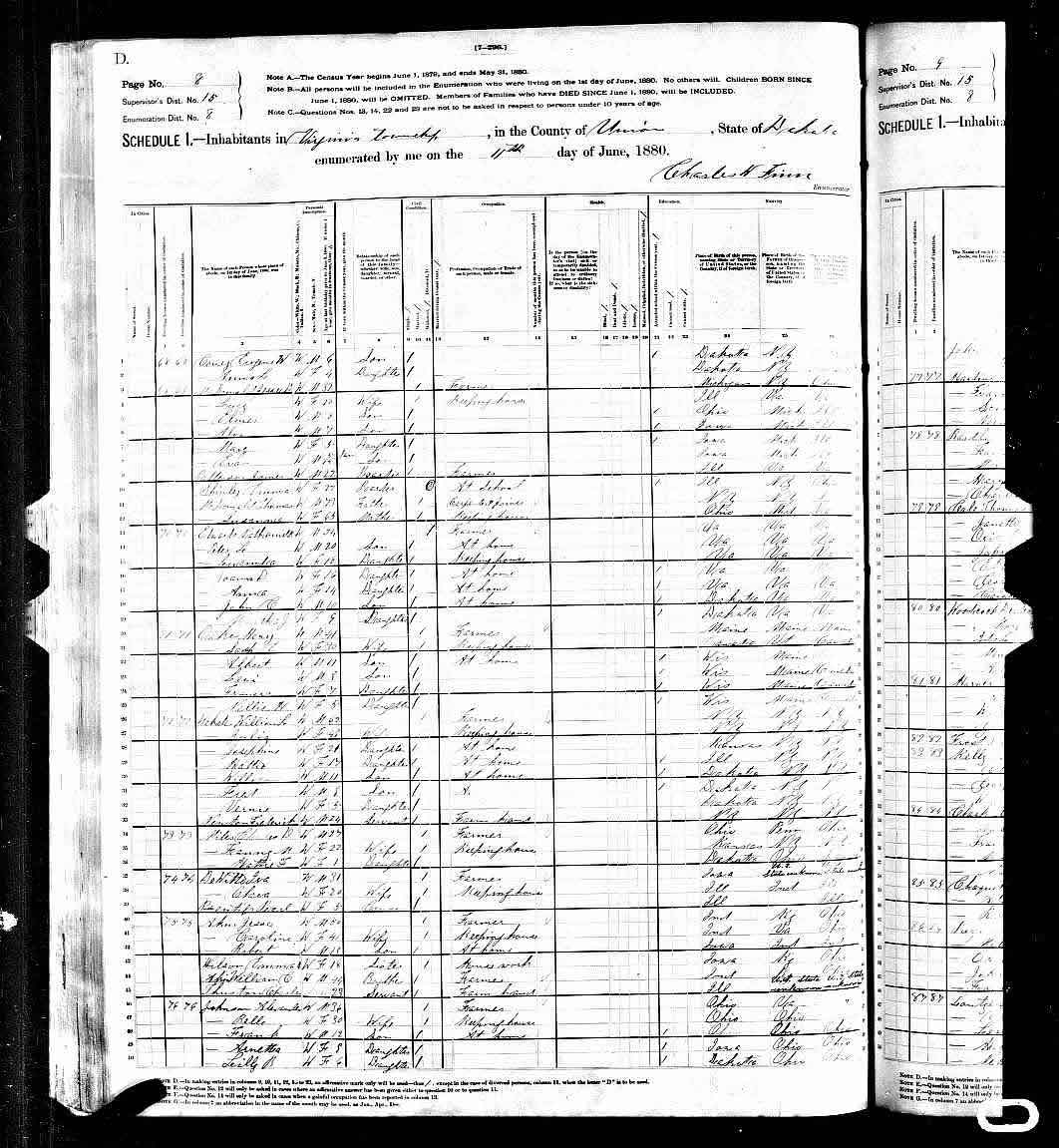
| 1880 US census, Dakota Territory, Virginia Township, Union County |
The 1880 US Census records the fact that Frank Ottley Miles, his wife Fannie Brewster Miles and their one-year-old daughter Hattie lived on a farm in the southeast corner of Dakota Territory, Virginia Township, Union County. The farm was in the James River Valley north and east of Yankton. The census record is hard to read so I have cropped the image to reveal the names of Charles, farmer, age 27, Fannie, keeping house, age 21, and Hattie, age one. Hattie's place of birth is Dakota, so we know that the Miles family came to the Dakotas before 1879.
 |
| detail of 1880 US census |
The land that the Miles family settled was formerly land owned by the Sioux. In 1858, the Yankton Sioux signed the 1858 Treaty, ceding present-day eastern South Dakota to the United States.
 |
| Middle Missouri River by Lewis and Clark, pub. 1814 |
Detail of Lewis and Clark map of the middle Missouri River, image from Wikipedia. The annotations states that between the Jacques [James] and Sioux rivers, "the different bands of the Sioux Indians meet each Spring to trade with each other and with white Traders who visit them."
Question: When did Frank and Fannie Miles arrive in Dakota territory?
In truth, I don't know. Nor do I know when they left, although I do know by the time of the 1900 census, the family moved on to Oklahoma where they again took up farming near Stillwater. The answer to both \questions should lie in the court records of the county where they lived. There the Register of Deeds would have recorded the Homestead claim that was filed, for a fee of $14, and the subsequent sale, when the family moved on to Oklahoma.
Question: What did Frank and Fannie find when they moved to the Dakotas?
The simple answer is not much. In 1880 there were few towns, few railroads, the James River Valley was just a flat fertile stretch of land that was eagerly sought by homesteaders. So eager were farmers for land in the Dakotas that between 1880 and 1890, the population of the entire Dakota Territory, both south and north, jumped threefold from 135,000 to over a half a million souls. They came, for the most part, with not much in their pockets. They through up simple frame house, or sometimes a sod house, where wood or money was scarce, and commenced to farm. To give one a sense of the magnitude of the land rush, consider that in 1880, when Frank and Fannie had already established their claim, almost 3 million acres were filed on. By 1884, this figure rose to over 11,000,000 acres. Read The Farmers' Frontier, 1865-1900, by Gilbert C. Fite, for a good discussion of the Dakota Land Rush.
Question: How did they fare?
There are no diaries or personal records of the young Miles family that record their years in the Dakotas. History records a great blizzard that first stuck in October of 1879 and continuing on throughout winter, dropping over ten feet of snow. School children were caught unawares by the sudden October snow storm and hundreds died of cold. The late spring that arrived eventually melted the snow and turned the flat James River Valley into an ocean of water. Still, new immigrants came. And those that survived the winter and the floods prospered in the early years. Bountiful rains throughout the early 1880's meant good crops, usually wheat, but also corn, rye, and barler, which allowed the farmer to earn a good living for his family.
By 1884, the Miles family had a new addition, a baby boy named Charles Dalles Miles. He was born in Sioux City, Iowa. That he was born there might suggest that the farm had been abandoned, or it might simply mean that Fannie had returned to Iowa to be near family or a hospital.
The Dakota land boom continued in 1885 and 1886 with new farmers arriving plowing up the tall prairie grass where buffalo once grazed and planting cereal grains instead. The year 1886 was to be a watershed, when drought again returned to the prairies and falling wheat prices aggravated plight of the farmer. In 1889, statehood finally came to North and South Dakota. Even then, by 1889-1890, the drought affecting the mid-west had become so bad that land that previously yielded 20 or more bushels and acre, were now down to 2 bushels or less. And, by the early 1890's, carloads of coal, food, and clothing was directed from the east to aid the struggling farmers and their families. Accompanying this natural disaster was the economic Panic of 1893. As a result of the bank panic, railroads which had been overbuilt, collapsed, banks which lent money on risky investments collapsed, wheat prices the source of the farmers income collapsed, mortgages were called, and farms foreclosed.The Panic of 1893 was, at the time, the worst depression experienced by the United States.
Some farmers, like the Miles family moved on, some adjusted by changing their farming practices, resorting to livestock, irrigating, or just plain luck of a fortunate rainfall, bringing in a crop. But all those families, like the Miles family demonstrated a desire to make something of nothing, to settle down and create a new life.
Read:
1. History of Union County, Dakota Territory
2. History of South Dakota, pub. 1915
3. Digital Library of South Dakota
4. History of Dakota Territory, by George Kingsbury, pub. 1915.
5. A History of Union County, South Dakota, to 1880

