Sunday, May 25, 2014

Dr. William James Phillips


Dr. William James Phillips was a rural doctor and surgeon for the Frisco Railroad in Beaumont, Kansas. In 1885 he came to Kansas, moved to Beaumont in 1895 and lived there until his death in 1929.

This article is based primarily on the two sources mentioned.

[Dr. William James Phillips' daughter Beulah married Fred Van Huss, and so is the maternal grandfather of Robert Van Huss, my father-in-law.]


The country doctor of the 1880’s and 90’s was a general practitioner delivering babies, setting broken bones, pulling teeth, tending snake bites, and wounds from gun shots and farm equipment. The country doctor might live on his own farm to make ends meet, and so would travel by horse or buggy to treat patients in outlying farms. They likely delivered every child within miles, and sat with the dying as they left this world for a better place, and these happenings often required a doctor to get up in the middle of the night to attend his patient. As cash was short on the prairie, the pay for a doctor might be a basket of eggs, a bushel of corn, or a side of beef.


WILLIAM JAMES PHILLIPS, M. D.

[source: http://skyways.lib.ks.us/genweb/archives/1918ks/biop/philliwj.html]

The Phillips family originated in Wales. William James Phillips' paternal grandmother was Irish, coming to America at the age of nine. This paternal side of the Phillips’ family came to America in colonial years, later moving west  to Ohio, then Iowa, and finally, with William James Phillips to Kansas.

William James Phillips (1856-1929) was born in Washington County, Iowa on October 2, 1856. He was the second son of George Phillips and Susanna (Deen) Phillips.

William grew up near Iowa City. He attended public schools and an academy. In 1874, at the age of 18, William spent 15 months working on a farm along the Little Blue River near Washington, Kansas, (north of Manhattan and Clay Center and west of Marysville).

Six years previous, Cheyenne and Arapahoe had made a raid in the county. Four years previous, the Kansas Pacific Railroad completed its line along the Smoky Hill River from Kansas City to Denver.  Buffalo still roamed western Kansas.

http://www.kancoll.org/books/cutler/washington/washington-co-p1.html

In 1885 William graduated from the College of Medicine, State University of Iowa. [Announcement of the College of Medicine, the State University of Iowa, 1885-1886,
 https://archive.org/details/announcementof8586stat.] After graduation, Dr. Phillips settled in LaCrosse, Kansas to practice medicine, marrying the same year Maggie Z. Redman (1867-1958), (daughter of A. J. and Mary (Wright) Redman).

In 1895 the couple moved to Butler County and Beaumont where Dr. Phillips worked as surgeon for the Frisco Railroad. They bought a 130 acre farm at the southwest edge of town.

Page 32, 1905 Butler County Atlas, Glencoe Township


Dr. Phillips served as town clerk. He operated a drug store and acted as pharmacist. He was a Republican, and a member of Beaumont Lodge No. 465, Ancient Order United Workmen.

The Phillips family grew to eleven sons and daughters.

Clarence M. farmed 3 1/2 miles southwest of Beaumont; Hubert W. worked as a brakeman with the Grand Trunk Pacific Railway and lived at Biggar in Saskatchewan, Canada; Edith Fern was the wife of A. L. Milliken, station agent for the Frisco Railway at Altamont, Kansas; George A. drove an auto stage at Brawley, California; Pauline, the fifth child, died at three years of age; Helen M. is the wife of J. H. Nichols, an express messenger in Wichita; Beulah M. was a school teacher and would marry Fred Van Huss; as of 1918, Paul W. was attending a school of automobile instruction at Wichita and the three youngest Alwilda, Wendell and Ruth, were attending public schools in Beaumont.

Beaumont Cemetery, William J. Phillips and Margaret Z. Phillips


William died in 1929 at Beaumont and is buried in the Beaumont Cemetery just north of Highway 400. His wife Maggie died in 1958 and is buried next to him.

George Phillips

William's father, George Phillips (1814-1873), was born in Ohio on February 10, 1814. He was an early pioneer of Washington County, Iowa and died in Daytonville, Iowa on February 6, 1873. His career included farming, general store and hotel owner. He was a member of the Methodist Church and served both as steward and trustee. In politics he was an active republican.

[I find nothing of the family history of the Phillips before George.]

George Phillips married three times. He first married Elizabeth Deen, a native of Ohio. She died in Illinois and was the mother of ten children.

His second wife Susanna Deen (1831-1856) was a half-sister of his first wife. She died at Daytonville, Iowa, October 9, 1856, one week after the birth of William J. Phillips. She had one other child, W. S..

George Phillips married his third wife Judith R. Downing. Her only child, Thomas A. L., died at seventeen months.

Tuesday, February 18, 2014

Brownlow Cemetery, Butler County, Kansas


The name Brownlow is a mystery, but there is a clue in a short bio of Hickory Township by J.O. Evertson, in Mooney's History of Butler County, Kansas.

Among the next arrivals [in Hickory] were J. A. Armstrong, who bought out Mr. Myers, and established a general store at Old Brownlow.
Id. page 160.


Brownlow cemetery lies on a bluff between Hickory and Honey Creeks. It is a bit tricky to get there and the turn off of 135th street is not marked. Take Highway 400 east of Augusta and Leon until you come to Munson Hill Road. Turn south on the gravel and make your way to 132nd street. Turn left on 132nd street and then right on Grove Road, a quick right on Hickory Road. The cemetery is off to the left.

Brownlow Cemetery, googleMaps


Brownlow Cemetery

Brownlow Cemetery, looking east
The cemetery is the resting place of many early settlers in Hickory Township.

Brewer Family

Include are the Brewer family that arrived in 1881. James Madison Brewer and Margaret Faubion Brewer came to Kansas by way of Allentown, Missouri, where they had lived 20 years; and they settled not far from Latham, Kansas.

When they came to Butler County (Kansas)-they came in covered wagons--three families together: Mary Jane & Joseph T Wright, Margaret & James BREWER, and Hephzibah "Aunt Hippy" & Mathew Hightower. The Hightower's son Otto took sick on the way, and they camped at Eureka (Greenwood County, KS) with him for 'quite a while.' The other families stayed with them for about a week before moving on. Otto died and was buried in Eureka Cemetery before the Hightower's wagon left camp to join the others in Butler County.

Brewer family history.


Wright family, Brownlow Cemetery
Brewer family, Brownlow Cemetery
Sensenbaugh family

In 1873 Paul and Sarah Sensenbaugh settled in Hickory Township, Butler County. Their son Henry was included in Mooney's History of Butler County at page 833.

He located on 160 acres of land and after getting four ponies, one of which was a spotted one, he proceeded to break his prairie land. His outfit might have seemed more appropriate in a circus parade, but he succeeded in tilling the soil and raising a crop with them. He also used oxen in the early days and frequently drove to dances with his ox team outfit. ... 

Miles, Charles Dallas

Brownlow Cemetery is also the resting place of Major Charles (Charlie) Miles (1921-2001) who served during World War II in China.

Major Charles (Charlie) Dallas Miles

Charles Dallas Miles, 1921-2001

Sunday, May 12, 2013

Beaumont 1905

Beaumont, Kansas from the Kansas Atlas of 1905
The Standard Atlas of Butler County, Kansas, 1905, contains the plat map for Beaumont, Kansas as well as for all the townships and cities of Butler County.

John Finley Van Huss (born 1859, Elizabethton, Tennessee) is the great grandfather of Robert Van Huss. He settled in Butler County in 1885, purchasing a claim near his brothers in Glencoe Township for 160 acres from the Osage Trust. This deed is found in the Register of Deeds office in the county courthouse in El Dorado, Kansas.

On June 4th, 1903,  John Finley Van Huss purchased four lots in Beaumont by tax deed. The deeds are for lot 2, block 5 of Cooper's Addition; and for lots 6 and 7 of block 5 of Summit, and lot 10 of block 6 of Summit.

Beaumont 1905 Kansas Atlas


I have also included a portion of the map revealing the location of the old round house. Note the residence of Dr. William James Phillips, bob's maternal grandfather and the Beaumont town doc.

Latham Kansas 1905
I haven't yet found an image of Beaumont Kansas in 1905. Instead, I have one from Latham, a town where J. F. Van Huss bought lots in 1902.


Van Huss

Approaching Beaumont, Kansas from the west on Highway 400, just before you get to Beaumont, look to the left and there sits 480 acres of land (or is it 640 acres?) which once belonged to four or five brothers with the last name Van Huss. I say four or five because I am uncertain of the property records found in the county courthouse in El Dorado. The claims are there, reflecting the purchase of land from the Osage Indian Trust, but the deeds were filed over several years, and there was a little give and take between brothers.

This  land is pasturage, lying as it does at the top of the Flint Hills between Butler and Greenwood counties. The Google Map of the property shows the beginnings of a creek that eventually becomes the Little Walnut River.

One can walk the land and find a stone foundation for a house long gone. Near by stands an iron pump made in Rockford Illinois.

Google Map Glencoe Township


In the early days of my marriage, my wife's family would make numerous Sunday outings to Beaumont. We traveled by car from Wichita, heading east past Augusta, then Leon, and out into the treeless Flint Hills. Today, the trip takes perhaps 40 minutes, and in Beaumont, you can enjoy the serenity of the Flint Hills and good food at the historic Beaumont Hotel.

In olden days, we went on the Sunday before Memorial Day. First, there was a visit to the Beaumont Cemetery and the family graves. Then we enjoyed a softball game in Bob's front yard - Bob owned two houses on Main Street. Occasionally, we made a short fishing trip to the local pond where the fish never seemed to bite.

In Beaumont, my wife's father, Robert (Bob) Van Huss kept two homes. They were not grand homes, Beaumont has few of those, but they were sturdy, attesting to the values of the early settlers. Among those early settlers were Bob's father and grandfather who arrived by covered wagon and horse in the 1870's.

Bob proudly mentioned that his grandfather on his mother's side, Dr. James W. Phillips, was the doctor for Beaumont and the Frisco Railroad, which made Beaumont a hub. He also spoke of the farm that his father's father once had off to the south and east of Beaumont. But never did I hear him speak of land to the north of Beaumont. So, what am I to think of this Butler County Atlas of 1885, which identifies a Van Huss owning 480 acres.

Detail of Kansas Atlas, 1885, Butler County, southeast corner of Glencoe Township

The property is pasture land today. The land drains from the south and north into a creek which crosses the land to the west, eventually forming the Little Walnut River near Leon, Kansas. A dike at the west end of the property forms a lake that centers on Summit Road.

I parked the car just off Highway 400 and on Summit Road, just before one gets to the lake. I took the dogs Sammy, a German Shepherd, and Tobie, a Australian Shepherd and Mountain Cur mix, on a walk. The cattle were gone, but they had left reminders of their presence.  We headed east avoiding the cow droppings early settlers prized when their was no wood to be found. One can follow the shallow creek bed or head out into the field which still contains chert here and there. It is the chert, which settler called "flint" that gives the area its name, the Flint Hills.

On the south side of the creek is an old pump and the stone outline of the foundation of a building. Perhaps, it is the house of old man Van Huss and his family.

Looking east toward Beaumont, property of old man Van Huss


Notes.

1. If you examine the map for Glencoe Township, you will notice the initials "J.W.P" which in all certainty stand for James William Phillips.

2. The pump is made by Ward of Rockford, Illinois. I can't seem to find out much information on the pump other than a listing for "Ward Pump Co. Manufacturers of Iron Pumps and Cylinders. Frank Ward, President. Frank Lane, Secretary" from a map of Rockford, Illinois, 1891.


Ward Pump, Rockford Illinois
Now I need to go back to the Register of Deeds Office in El Dorado, Kansas amd search the title records for this property.

Beaumont Cemetery

Beaumont cemetery is one of two cemeteries in Beaumont, Kansas. It lies at the northeast corner of the city on the north side of Highway 400. The cemetery is perhaps an acre in size. It is the resting place for almost 200 souls. (Beverly Horner has recorded the names of 194 individuals in the Beaumont Cemetery. See Interment.net.)

The cemetery serves the pioneer families who settled Butler County near the headwaters of the Little Walnut River. This includes the townships of Glencoe and Hickory and the city of Beaumont. Included in those families are the ancestors of Robert and James Van Huss and their extended families. Other families include the Phillips, Edgars, Ferrells, Wassons, Northingtons, Axtells, Burrises, and Robinsons, to name but a few.

The date of the cemetery's opening is unknown, but early tombstones include  Elizabeth Wails (died January 8, 1887, age 56, 4 months, 21 days)  and Thomas Wails, (died December 17, 1887, age 59, 4 days). *

Thomas Wails, Beaumont Cemetery, died 1887


Settlement of Butler County and the Walnut River Valley began as early as the 1850's, but title to land was always uncertain until the final removal of the Osage and other tribes, which did not take place until the early 1870's. ** The historic Beaumont Hotel was built in 1879, and previous to that the location served as a stagecoach stop for the route between Fredonia and Wichita, Kansas. The post office came to Beaumont in 1880. And in 1885, the Frisco railroad come to town, connecting St. Louis to the east and Wichita to the west. Beaumont served as a refueling and service center. Its location at the top of the climb though the Flint Hills and Greenwood County making it ideal.

If cemeteries could speak they would reveal countless tales of heartbreak and sadness. For instance, there is the headstone of Orville and Mary Northington. Orville lived from 1889 until 1969. His wife Mary Kellie from 1890 until 1967. Next to their beautiful granite headstone are three well-preserved concrete headstones marking the deaths of Clara Northington, born May 15, 1934, died May 19, 1934; Irene, born November 25, 1931, died July 22, 1934, and; Oliver, born September 1930, died January 1932. Their stories are lost to time, but it is well to remember that Kansas in the 1930's was a decade of drought and dust storms.

Clara, Irene, and Oliver Northington, Beaumont Cemetery


*William Thomas Wails had at least one daughter, Mary Ann Wails (1883 - 1962).  She was born in Beaumont, Kansas, USA on 1883 to William Thomas Wails and Lettie Jane Mead. Mary Ann married John Oscar Strader and had 8 children. Ancestry.com.

** The Osage Indian settlements in southeast Kansas were primarily in Montgomery County, near present day Independence. However, the Osage Indians crossed Butler county in a well marked trail on their way to hunt the plains buffalo. Read more about the Indian Reserves in Kansas.

Wednesday, April 10, 2013

The Great Dakota Boom

There will always be questions and questions will always remain unanswered. The question is why Frank and Fannie Miles settled in the Dakota Territory sometime before 1880 and why they left. Frank and Fannie Miles are the great-grandparents of my wife, and the grandparents of Charlie Miles, Mary Van Huss, and Joan Smith. They are the great-great-grandparents of my children Hannah and Will Davis.

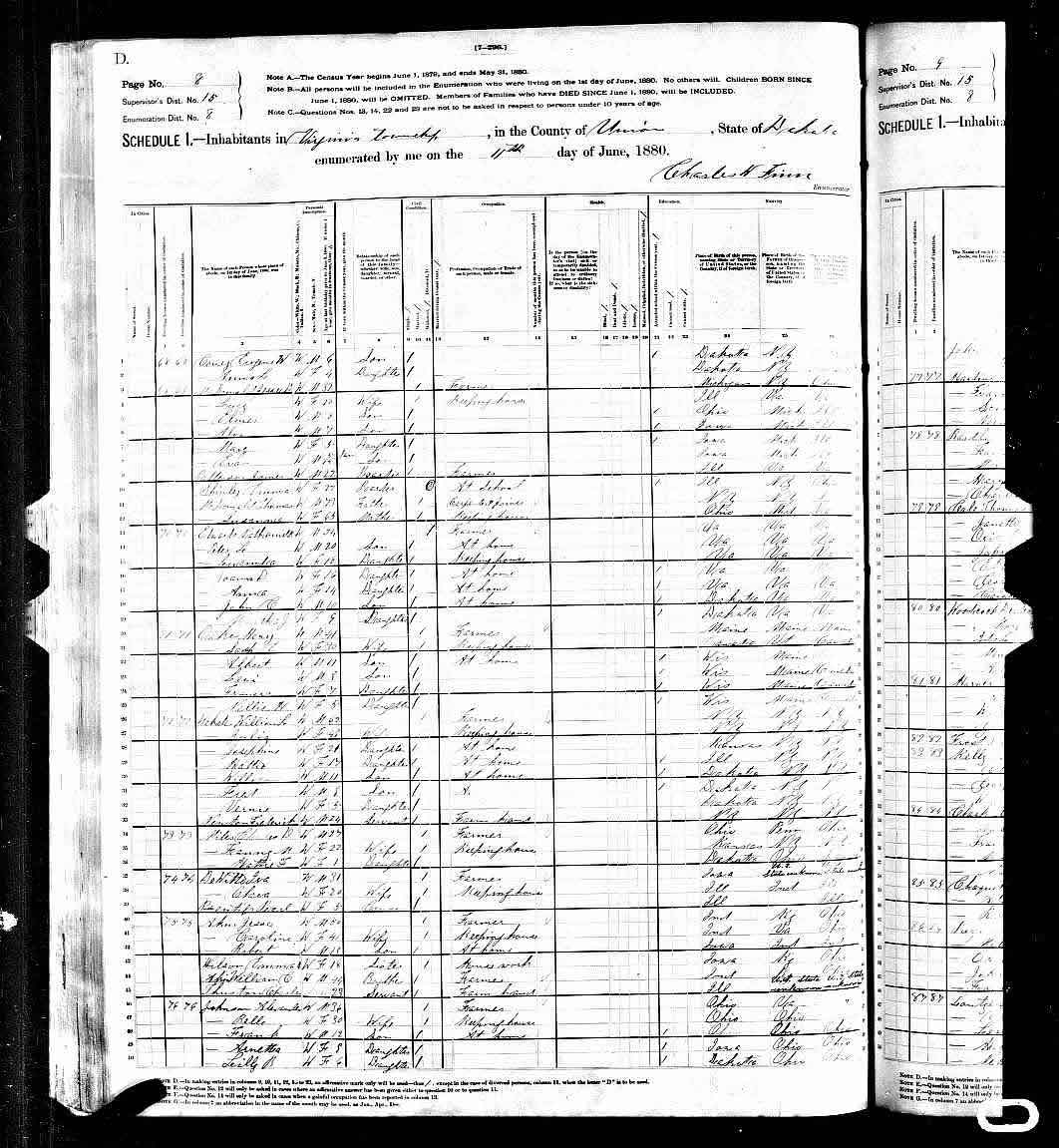
1880 US census, Dakota Territory, Virginia Township, Union County


The 1880 US Census records the fact that Frank Ottley Miles, his wife Fannie Brewster Miles and their one-year-old daughter Hattie lived on a farm in the southeast corner of Dakota Territory, Virginia Township, Union County. The farm was in the James River Valley north and east of Yankton. The census record is hard to read so I have cropped the image to reveal the names of Charles, farmer, age 27, Fannie, keeping house, age 21, and Hattie, age one. Hattie's place of birth is Dakota, so we know that the Miles family came to the Dakotas before 1879.

detail of 1880 US census

The land that the Miles family settled was formerly land owned by the Sioux. In 1858, the Yankton Sioux signed the 1858 Treaty, ceding present-day eastern South Dakota to the United States.

Middle Missouri River by Lewis and Clark, pub. 1814

Detail of Lewis and Clark map of the middle Missouri River, image from Wikipedia. The annotations states that between the Jacques [James] and Sioux rivers, "the different bands of the Sioux Indians meet each Spring to trade with each other and with white Traders who visit them."

Question: When did Frank and Fannie Miles arrive in Dakota territory?

In truth, I don't know. Nor do I know when they left, although I do know by the time of the 1900 census, the family moved on to Oklahoma where they again took up farming near Stillwater. The answer to both \questions should lie in the court records of the county where they lived. There the Register of Deeds would have recorded the Homestead claim that was filed, for a fee of $14, and the subsequent sale, when the family moved on to Oklahoma.

Question: What did Frank and Fannie find when they moved to the Dakotas?

The simple answer is not much. In 1880 there were few towns, few railroads, the James River Valley was just a flat fertile stretch of land that was eagerly sought by homesteaders. So eager were farmers for land in the Dakotas that between 1880 and 1890, the population of the entire Dakota Territory, both south and north, jumped threefold from 135,000 to over a half a million souls. They came, for the most part, with not much in their pockets. They through up simple frame house, or sometimes a sod house, where wood or money was scarce, and commenced to farm. To give one a sense of the magnitude of the land rush, consider that in 1880, when Frank and Fannie had already established their claim, almost 3 million acres were filed on. By 1884, this figure rose to over 11,000,000 acres. Read The Farmers' Frontier, 1865-1900, by Gilbert C. Fite, for a good discussion of the Dakota Land Rush.

Question: How did they fare?

There are no diaries or personal records of the young Miles family that record their years in the Dakotas. History records a great blizzard that first stuck in October of 1879 and continuing on throughout winter, dropping over ten feet of snow. School children were caught unawares by the sudden October snow storm and hundreds died of cold. The late spring that arrived eventually melted the snow and turned the flat James River Valley into an ocean of water. Still, new immigrants came. And those that survived the winter and the floods prospered in the early years. Bountiful rains throughout the early 1880's meant good crops, usually wheat, but also corn, rye, and barler, which allowed the farmer to earn a good living for his family.

By 1884, the Miles family had a new addition, a baby boy named Charles Dalles Miles. He was born in Sioux City, Iowa. That he was born there might suggest that the farm had been abandoned, or it might simply mean that Fannie had returned to Iowa to be near family or a hospital.

The Dakota land boom continued in 1885 and 1886 with new farmers arriving plowing up the tall prairie grass where buffalo once grazed and planting cereal grains instead. The year 1886 was to be a watershed, when drought again returned to the prairies and falling wheat prices aggravated plight of the farmer. In 1889, statehood finally came to North and South Dakota. Even then, by 1889-1890, the drought affecting the mid-west had become so bad that land that previously yielded 20 or more bushels and acre, were now down to 2 bushels or less. And, by the early 1890's, carloads of coal, food, and clothing was directed from the east to aid the struggling farmers and their families. Accompanying this natural disaster was the economic Panic of 1893. As a result of the bank panic, railroads which had been overbuilt, collapsed, banks which lent money on risky investments collapsed, wheat prices the source of the farmers income collapsed, mortgages were called, and farms foreclosed.The Panic of 1893 was, at the time, the worst depression experienced by the United States.

Some farmers, like the Miles family moved on, some adjusted by changing their farming practices, resorting to livestock, irrigating, or just plain luck of a fortunate rainfall, bringing in a crop. But all those families, like the Miles family demonstrated a desire to make something of nothing, to settle down and create a new life.

Read:
1.  History of Union County, Dakota Territory
2.  History of South Dakota, pub. 1915
3.  Digital Library of South Dakota
4.  History of Dakota Territory, by George Kingsbury, pub. 1915.
5.  A History of Union County, South Dakota, to 1880

Tuesday, April 2, 2013

Beaumont, Kansas

Beaumont, Kansas was once a stagecoach stop on the route between Fredonia and Wichita.

In 1879, it was there, at the top of a steep grade at the northeast corner of Butler County, bordering Greenwood County, that Edwin and Emma Russell built the Summit Hotel. The hotel remains, now rebuilt and renamed the Beaumont Hotel.

The name of the stagecoach line eludes the records - there were many that operated in Kansas after the Civil War, including: The Butterfield, Southwestern Stage Company, the Fort Scott Stage Company, the Southern Kansas Stage Company, and others. Skyways. The stage itself was pretty much the way it is depicted in old western movies, a rocking cradle pulled by four horses. On top rode the driver and one carrying  a shotgun for protection.

Those extolling Kansas and its climate wrote:

The climate is good. The atmosphere is clear and dry and of remarkable purity. Winters are said to be dry and very short, and cattle can graze out nearly the whole year. The heat of the summer is moderated by the pleasant zephyrs which continually sweep across the broad prairies.
 
Winfield Messenger, August 30, 1872.

Southwestern Stage to Winfield, Kansas
Those who knew the truth, mostly kept it to themselves. But Kansas in the early years was subject to prairie fires, drought, locusts, and the vicissitudes of life.

Read a bit of Mark Twain's Roughing It, an account of his trip by stagecoach.

The Frisco

In 1885, the St. Louis and San Francisco Railroad, better known as the Frisco, established Beaumont as a railroad town with a water tower and engine house. For a short time afterwards, it was a collection point for cattle shipped back east.

Beaumont, Kansas Railroad terminus 1918

Today, the railroad is gone, as are most of the cattle, and many of the people who serviced the railroad and the cattle industry, but Beaumont continues on as a private airstrip for pilots who want to fly in on the week-end.